
Feline asthma: diagnosis, treatment and control
By Victor Costa, veterinarian (CRMV MG 21605, Brazil) · September 13, 2026 · 7 min
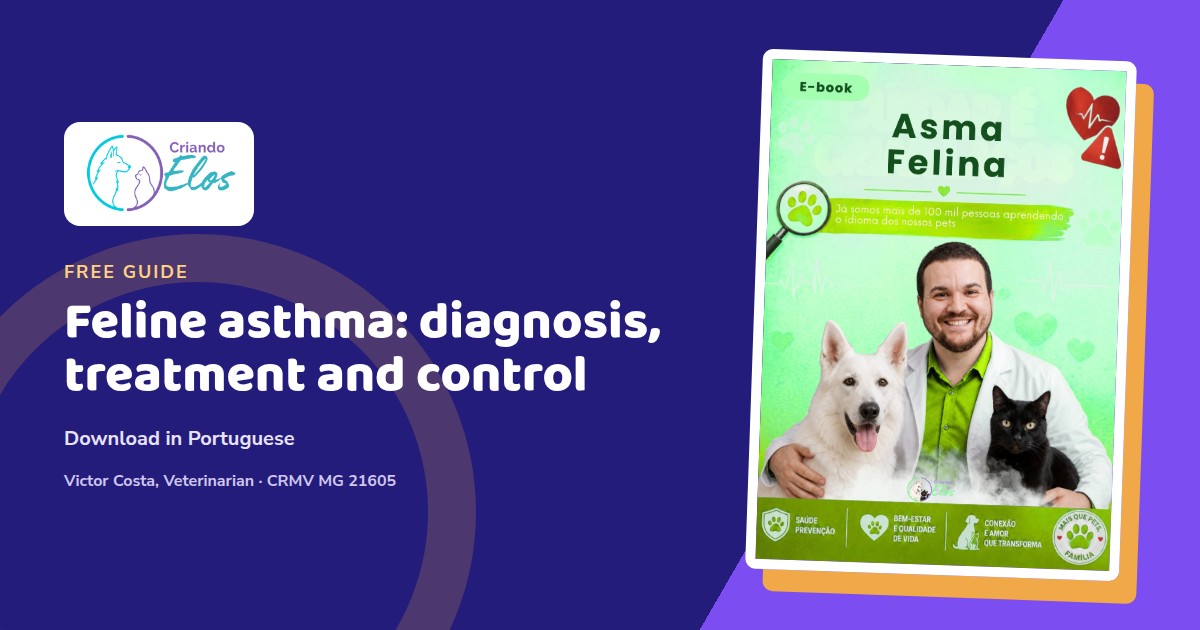
Editorial composition based on the original Criando Elos ebook.
The coughing stopped, your cat returned to bed and the house went quiet. That does not tell you whether airway inflammation is controlled. With feline asthma, care between attacks matters alongside knowing what to do when breathing becomes difficult.
This article brings together the Criando Elos Feline Asthma ebook and veterinary references on investigation and treatment. It is an educational summary to support conversations with your veterinary team, rather than an examination or an individual prescription.
Breathing difficulty needs immediate care
Go to an emergency veterinarian now if your cat breathes with an open mouth, makes obvious chest or abdominal effort, has blue or grey gums, becomes severely weak or collapses. Do not wait for a colour change, several signs together or an attack to last a certain time.
Call the hospital while arranging transport and keep handling to a minimum. Do not force water, food or tablets, or open the mouth to inspect the gums. If your cat already has a prescribed rescue plan, follow those instructions without delaying departure.
Even a cat with diagnosed asthma can develop breathing trouble from another cause. Cornell advises immediate veterinary attention whenever there is doubt about comfortable breathing. The emergency team decides how to stabilize the patient before completing the investigation.
What asthma does to the airways
The bronchi carry air within the lungs. In asthma, inflammation makes these airways more sensitive; narrowing, swelling and mucus interfere with airflow. Coughing, wheezing and increased breathing effort can occur, with varying severity.
The ebook explains the response to inhaled substances and possible consequences of uncontrolled attacks. Persistent inflammation can change the structure of the airways. A veterinary appointment therefore needs to address care between episodes, including periods when your cat seems comfortable.
You do not need to identify a particular household product before the disease can be investigated. Several factors are involved, and a trigger cannot always be found. Posture or a video alone cannot establish an asthma diagnosis either. For help describing an unfamiliar episode, read cat cough or hairball.
How a veterinarian investigates suspected asthma
The history covers when coughing started, its frequency, environmental exposures and any medication given. The team examines your cat and decides which tests are appropriate at that point. Bringing previous results is useful, especially if different hospitals have been involved.
Chest X-rays may reveal changes consistent with bronchial disease, but cannot establish asthma on their own. An image without the expected pattern does not rule it out either. Cornell’s explanation, updated in July 2014, describes the lack of one definitive test and the need to exclude other causes. This diagnostic principle remains part of current veterinary references.
Chronic bronchitis, infections and lung parasites can produce similar signs. Heart problems may also need investigation when a cat has breathing difficulty, depending on the findings. Coughing and laboured breathing are separate observations: tell the team which you actually saw.
Blood tests help assess overall health and specific possibilities, but a blood count alone cannot exclude every infection. Some patients need airway fluid sampling, such as bronchoalveolar lavage, to examine cells and investigate microorganisms. Whether to perform the procedure, and its risks, depend on the cat’s stability.
Before agreeing to a test, ask what possibility it investigates, how the result could change care and whether your cat needs stabilization first. Improvement after borrowed medication is not a substitute for this assessment and can complicate interpretation of the history.
Ongoing treatment and a rescue plan serve different purposes
Treatment commonly includes a corticosteroid to reduce inflammation and, when indicated, a bronchodilator to relieve airway narrowing. The Merck Veterinary Manual, updated in September 2024, recommends bronchodilators as additional treatment rather than the sole treatment for asthma.
| Part of care | Purpose | What to agree with the team | Limitation |
|---|---|---|---|
| Inflammation control | Treat disease within the airways | Medication, delivery route and individual routine | Improvement does not justify stopping it yourself |
| Plan for worsening signs | Define what to do if signs return | The prescribed rescue treatment and when to leave for emergency care | It does not replace emergency assessment for breathing difficulty |
| Environmental changes | Reduce irritating exposures | Practical changes at home | They cannot guarantee freedom from attacks |
When inhaled treatment is prescribed, medication must reach the airways through suitable equipment. VCA’s instructions, updated in October 2025, describe a chamber and mask with gradual introduction for the cat. Ask for a demonstration, check the prescription and tell the team if administration is difficult.
Practice with the equipment when your cat is stable. Forcing an unfamiliar mask onto a cat struggling to breathe can delay care. Do not adapt a human inhaler prescription, change the number of applications or use another animal’s medication.
The abstract of Gareis and Schulz’s July 2026 review continues to identify inhaled corticosteroids as a main treatment and notes limited evidence for several alternatives. Do not replace prescribed care yourself because another therapy is advertised as new.
Discuss practical obstacles too: who can give medication, where the equipment will stay and how to obtain a refill before it runs out. Report missed administrations, problems with the mask or uncertainty about the device accurately. The team needs that information to create a plan you can follow.
Reducing irritants without experimenting on your cat
Smoke, dust and scented products deserve attention. Cornell lists dusty litter, aerosols and cleaning vapours among suspected exposures in susceptible cats. A pattern in the history does not prove that a product caused the disease.
Use this list for practical household changes, without scoring disease severity:
- Keep the home free of cigarette smoke and avoid incense or candles around your cat.
- Consider unscented litter that produces little dust.
- Avoid spraying products or stirring up dust with your cat beside you.
- Clean resting areas and ventilate safely, with measures to prevent escape.
- Record changes and what happened afterwards, without deliberately repeating an exposure.
For example, if episodes started after a litter change, bring the product name and dates to the appointment. This gives the team something to investigate; it is not a reason to provoke coughing with the same litter. Repeated product changes without notes make the history harder to interpret.
Environmental changes support treatment. Do not replace medication with steam, fragrances or home remedies intended to open the airways. If a household change is difficult, explain the obstacle so the team can help you choose workable priorities.
Following control between appointments
Record new episodes, recovery and difficulties with treatment. A brief entry such as “coughed while resting; no cleaning product was in use; usual treatment given” separates observations from guesses. Do not invent times or fill gaps in an episode nobody witnessed.
Ask whether you should measure breathing rate during sleep and what changes should prompt a call. Request a demonstration and record observations under similar conditions. A count that seems usual does not cancel out visible effort, an open mouth or weakness.
Follow-up visits allow the veterinarian to reassess control and medication delivery. Bring questions about changes in appetite, thirst or behaviour as well as respiratory signs. If coughing becomes more frequent or the plan is not working as expected, contact the team for reassessment instead of increasing treatment yourself.
Make instructions available to anyone who looks after your cat while you are away. Keep the maintenance routine separate from the plan for worsening signs, with the emergency contact easy to find. The guide on what to note before a vet visit can help organize this information.
Frequently asked questions about feline asthma
Can feline asthma be cured?
It commonly requires ongoing control. Treatment aims to reduce signs and attacks while protecting quality of life. A period without coughing does not establish a cure or mean the prescription can be stopped.
Can an X-ray confirm asthma on its own?
No. The veterinarian interprets imaging alongside the history, examination and investigation of other causes. Further assessment may also be needed when the X-ray does not explain the signs.
Can I use a bronchodilator only when my cat coughs?
Do not choose that approach yourself. A bronchodilator does not replace inflammation control. Ask for written instructions distinguishing maintenance treatment from action for worsening signs.
Does every cat with asthma need an inhaler?
The route depends on the patient and prescription. If an inhaler is indicated, the equipment and technique must suit your cat. Report difficulties giving treatment rather than trying to compensate with extra applications.
Will unscented litter solve the problem?
It may reduce an irritating exposure, but does not guarantee disease control. Litter choice belongs within environmental management alongside treatment. It is not a home diagnostic test.
Can I wait if my cat improves after an attack?
Improvement does not explain the cause. Episodes of breathing difficulty need assessment, and an open mouth, laboured breathing or weakness requires emergency care. A previous recovery cannot predict what will happen next time.
Bring your observations and current treatment plan to your veterinary team. The Feline Asthma ebook available after registration is in Brazilian Portuguese and complements this article. It does not replace veterinary care or provide an individual prescription for your cat.
Keep this guide for later
Enter your details to access the complete PDF. The downloadable material is in Brazilian Portuguese.
Material available in Brazilian Portuguese.Get the complete e-book
Enter your name, email and WhatsApp number. The download appears here after registration.
We could not send your details. Please try again.
Your details will register the request and allow communications related to Criando Elos.
Your e-book is ready
Asma felina
Download the Portuguese PDFMaterial available in Brazilian Portuguese.This article is educational and does not replace an appointment with the veterinarian. In an emergency, seek care immediately.