
Fever in dogs and cats: signs and when to seek help
By Victor Costa, veterinarian (CRMV MG 21605, Brazil) · September 07, 2026 · 7 min

Is your pet acting differently today? Start with what you can see.
What has changed in your pet?
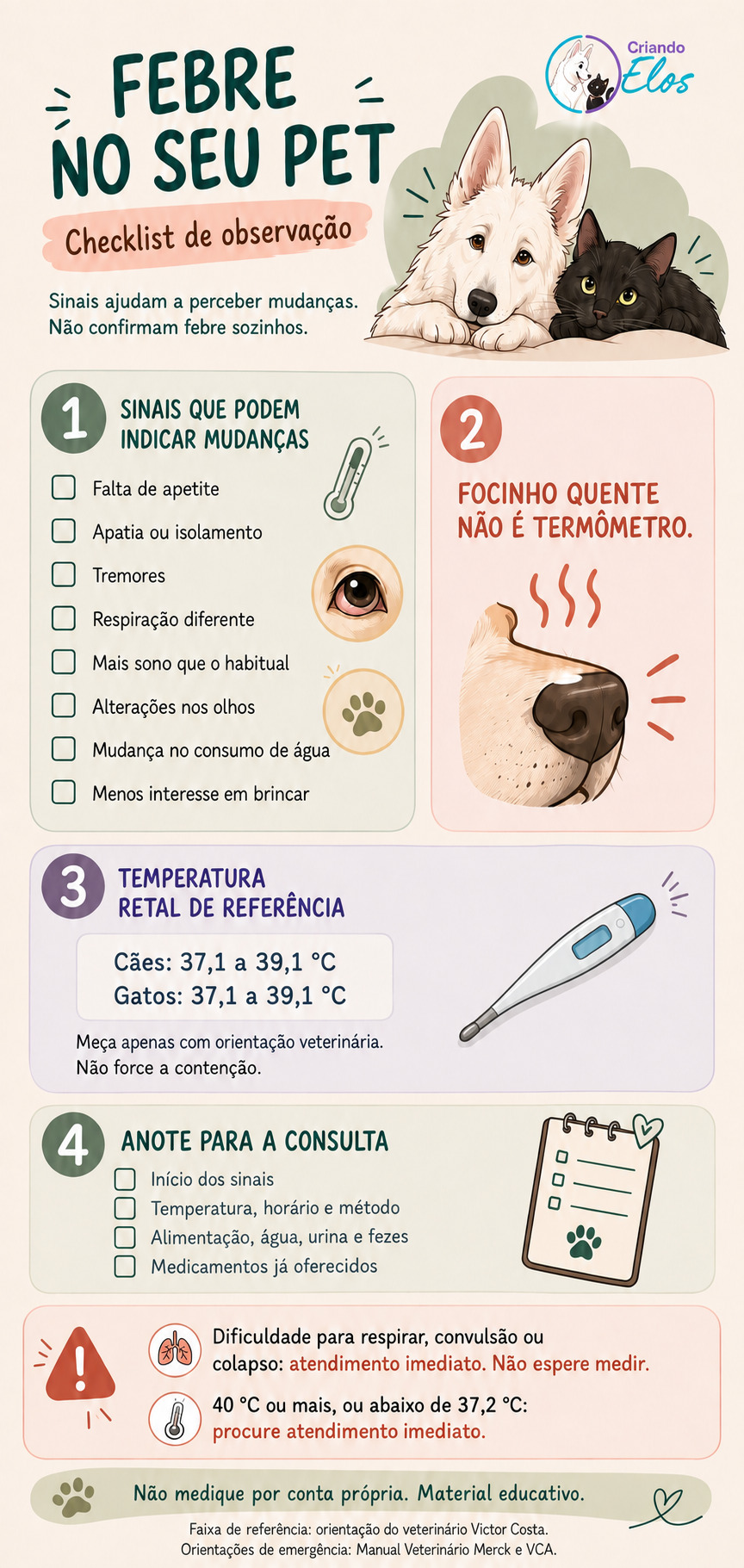
Select the changes you have noticed. This list records observations; it does not calculate risk or diagnose fever.
View my list
No observations selected.
Your selections stay on this page and are not sent with the form.Even one change may need attention. If it persists or your pet seems unwell, contact your vet today.
A warm nose does not confirm fever
Sunlight, rest and the surroundings affect nose temperature. Touch cannot replace an appropriate temperature reading.
Reference temperature
- Dogs
- 37.1–39.1 °C
- Cats
- 37.1–39.1 °C
Rectal temperature. A reading within the range does not rule out illness. Measure only with veterinary guidance and never force your pet.
Range used in this material as advised by veterinarian Victor Costa.
Keep the illustrated checklist
Enter your details to download the image on this page, ready to save or take to an appointment.
We could not send your details. Please try again.
Questions and answers about fever in pets
My cat's temperature is 39 °C. Is that a fever?
That reading falls within the rectal reference range for cats. Lethargy or refusing food still needs attention. A temperature within the range does not rule out illness.
Does a visible third eyelid confirm fever?
No. Tell your vet about it, especially if it is new or occurs with other signs. The appearance of the eyes cannot tell you your pet's temperature.
How can I measure safely?
Ask your vet to demonstrate the technique and recommend a device. Never force a frightened animal or one in pain. If your pet is unwell, prioritize care over repeated attempts to measure.
Does a warm, dry nose mean a fever?
No. Touch does not tell you the internal temperature. Watch your pet's routine and other signs; an appropriate reading helps the vet assess what is happening.
Do I need several signs before asking for help?
No. The number of boxes does not measure severity. Trouble breathing, for example, requires immediate care even if it is the only sign.
Can I give human medicine to lower the temperature?
Not without a veterinary prescription for that animal. If you have already given a drug, tell the team its name, amount and time, and bring the packaging.
What if I cannot take a temperature?
Do not force it. Describe the signs to your vet and ask for advice. If your pet is very unwell or has emergency signs, do not delay leaving to keep trying.
Fever in dogs and cats: the full guide
You know your pet’s habits: where they sleep, how they ask for food and what catches their attention. A change in that routine is worth noticing. Being quieter, refusing food or hiding are useful details for the appointment, but they do not identify the cause on their own.
The checklist above helps you organize those changes. More checked boxes do not confirm fever; an empty list does not guarantee that your pet is well. Treat it as a record of what you have noticed, without waiting to finish before seeking help.
Are fever and overheating the same?
No. With fever, the body changes its temperature regulation in response to an internal process. With overheating, heat can build up through environmental exposure or exercise. The Merck Veterinary Manual explains the distinction.
At home, useful details include whether your pet was in the sun, just exercised, received medication or was already behaving differently. A high reading needs attention, but it cannot identify the cause or tell you which medicine to give.
How to interpret a temperature reading
The rectal temperature range used in this material, as advised by veterinarian Victor Costa, is 37.1 to 39.1 °C for both dogs and cats. Do not compare it with human temperatures. A reading within this range does not rule out illness; tell your vet the reading and any signs you have noticed.
Record the exact number, time and method. A note such as “39.6 °C at 4 pm; rectal reading; resisted handling” is more useful than “felt hot.” This is an example of a record, not a diagnosis of that value. Tell the vet about agitation or difficulty measuring, too.
Both the device and technique matter. Ask your vet for a demonstration before trying. Avoid turning it into a struggle with an animal that is frightened or in pain. VCA describes thermometer precautions and limitations.
When to call the vet
40 °C or higher, or below 37.2 °C, calls for immediate care, according to VCA’s temperature guidance. Do not wait for these readings if your pet is unwell. Lethargy, refusing food or persistent changes warrant a call to your vet today.
After heat exposure, very rapid breathing, drooling, vomiting or poor coordination are also concerning. Move your pet out of the heat and arrange care. The Merck Veterinary Manual describes emergency signs in dogs and cats.
What to write down for the appointment
- When the signs started and what changed in your pet’s routine.
- Temperature, time and method, if you could measure safely.
- Food, water, urination, stools and any vomiting.
- Any medication already given, including its name, amount and time.
Do not give a human fever medicine or reuse another animal’s prescription. Some drugs can poison pets; acetaminophen is especially dangerous for cats. The FDA advises speaking to a vet before giving pain relievers.
If your pet seems better later
Write down what happened and watch whether their usual behavior returns. Tell your vet about recurring episodes. Apparent improvement does not explain the cause or undo an emergency that has already occurred.
The Criando Elos course organizes everyday care into lessons. The O Idioma Pet ebook provides further reading to consult at home. Both products are in Brazilian Portuguese. Neither replaces an examination or should delay care.
Clinical content reviewed and approved by Victor Costa, veterinarian (CRMV MG 21605, Brazil). Translation of the reviewed Brazilian Portuguese content.
This article is educational and does not replace an appointment with the veterinarian. In an emergency, seek care immediately.