
Brachycephalic syndrome: snoring is not cute
By Victor Costa, veterinarian (CRMV MG 21605, Brazil) · September 19, 2026 · 10 min
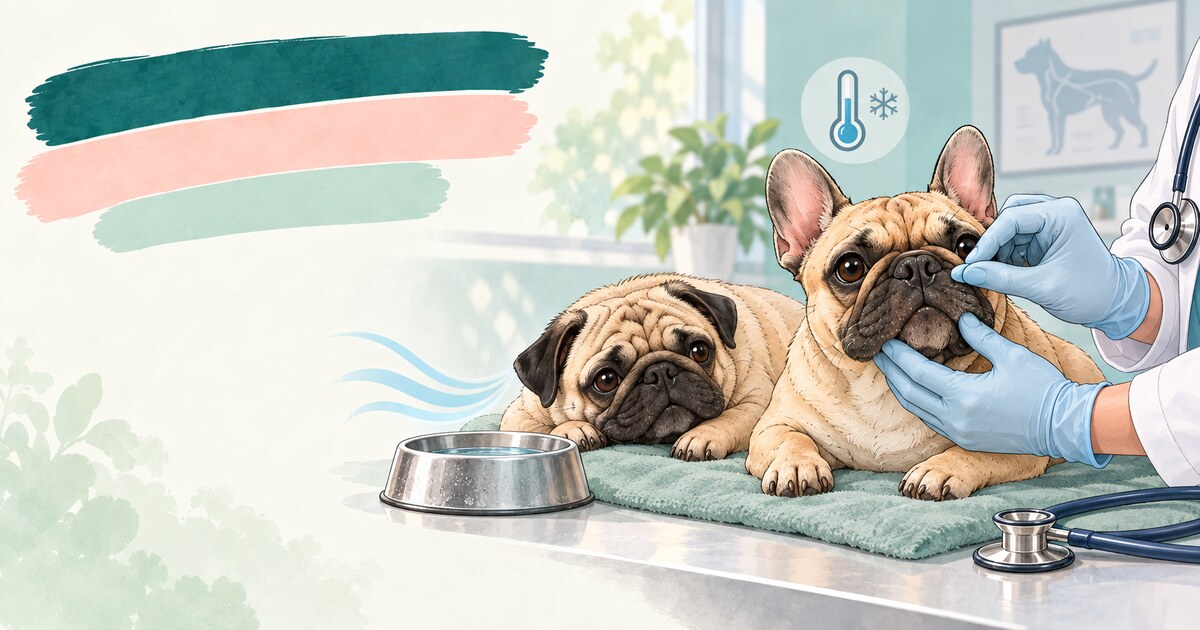
AI-generated illustration based on the artwork supplied to Criando Elos; composition editorially reviewed.
The bulldog snores and the family finds it charming. The pug pants after a short walk and looks merely “tired.” The Shih Tzu always has red eyes. These signs should not be accepted as the normal way the breed lives.
In short-nosed dogs, noisy breathing while awake, visible effort to draw air, exercise intolerance and difficulty recovering from heat can indicate brachycephalic obstructive airway syndrome, or BOAS. The flattened skull shape also increases the risk of eye disease. Not every animal has every abnormality, and severity varies widely even within the same breed.
What brachycephalic syndrome can involve
Selective breeding for a short muzzle and rounded head shortened the facial bones. The soft tissues did not shrink at the same rate. The tongue, palate and other tissues must fit into less space, while airflow may already be restricted at the nose.
The American College of Veterinary Surgeons describes stenotic nostrils, an elongated soft palate and everted laryngeal saccules among the common components. Some dogs also have a hypoplastic trachea or laryngeal collapse. The Royal Veterinary College also lists redundant pharyngeal tissue, a thick soft palate and changes inside the nasal cavity.
The abnormalities can compound one another. The animal creates stronger negative pressure to inhale. Repeated effort can pull laryngeal saccules into the airway and contribute to secondary laryngeal changes. The airway becomes even narrower just when the pet needs more air.
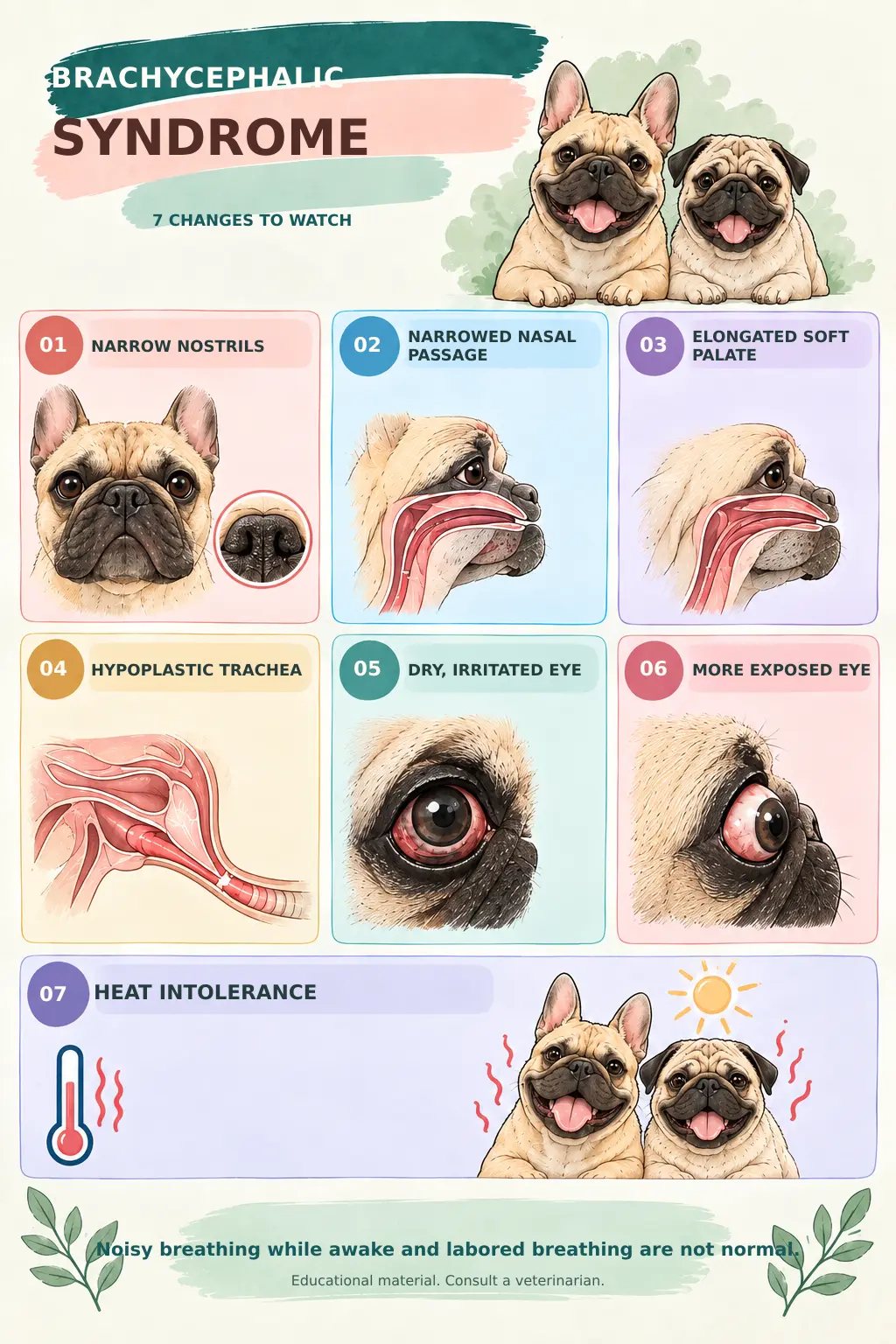
Seven problems linked to the same skull shape
The number seven organizes this explanation. It is not a closed diagnostic list. BOAS can involve other structures, and the two eye conditions below belong to brachycephalic ocular syndrome rather than the respiratory obstruction itself.
| Change | What can happen | What a family may notice |
|---|---|---|
| Narrow nostrils | Air entry is restricted from the start | Nostrils closing inward during inhalation, effort and noise |
| Narrowed nasal passage | Turbinates and other tissues occupy too much space | Noisy breathing, especially with the mouth closed |
| Long or thick soft palate | Tissue reaches the laryngeal opening and vibrates | Snoring, gagging and worsening during sleep or excitement |
| Hypoplastic trachea | The windpipe is narrower in some dogs | Less respiratory reserve; radiographs may help assess it |
| Abnormal tear film | Tears may be insufficient or unstable | Redness, discharge, discomfort and corneal injury |
| More exposed eye | A shallow orbit and incomplete eyelid closure leave the cornea vulnerable | Irritation, trauma, ulcers and risk of proptosis |
| Heat intolerance | Panting is less effective at losing heat | Slow recovery, restlessness, seeking cool floors and collapse |
These changes do not always occur together. Persian and other flat-faced cats can also have nasal obstruction and ocular disease, but feline disease should not be treated as an exact copy of the canine condition. Breed and appearance raise suspicion; they do not establish a diagnosis.
Signs that should not be normalized
A healthy dog breathes quietly at rest. The University of Cambridge advises families to watch for respiratory noise, narrowed nostrils, gastrointestinal signs, sleep disturbance, heat intolerance, blue mucous membranes and collapse. Some dogs seem comfortable at rest and show impairment only after controlled activity.
Arrange an assessment if you notice:
- Snoring or a harsh sound while the animal is awake.
- Excessive movement of the abdomen and chest with each breath.
- Interrupted sleep, an unusual sleeping posture or waking short of breath.
- Panting that is excessive for the activity or a long recovery time.
- Gagging, regurgitation or vomiting around breathing episodes.
- Red eyes, recurrent discharge, frequent squinting or rubbing the face.
A short video recorded without provoking exercise can help the veterinarian. Note the time, room temperature, previous activity and recovery time. Do not stage a running “test” at home to see how much the pet can tolerate.
When heat turns the condition into an emergency
Dogs lose heat mainly through panting. A narrow airway makes that mechanism less effective. As the animal overheats, panting increases, tissues can swell and resistance to airflow rises. The cycle can deteriorate quickly.
A Brachycephalic Working Group consensus statement reports a higher risk of heat-related illness in brachycephalic dogs. Exercise is a common trigger, and some animals may overheat at temperatures that seem moderate for other breeds.
Stop the activity and seek immediate care if the pet cannot settle, has marked difficulty drawing breath, becomes weak or confused, vomits repeatedly, develops a blue tongue or gums, faints or collapses. Move the animal to a cool place and follow the veterinary team’s instructions during transport. Do not wait for breathing to “return to normal” on its own.
Why the eyes need attention too
A shallow orbit makes the globe more prominent. The eyelids may not close fully, blinking may distribute tears poorly, and hairs from the nasal fold may touch the cornea. The tear film may also have an insufficient watery layer or evaporate too quickly. Abnormal tear ducts affect drainage, but they are not the glands that produce tears.
A review of brachycephalic ocular syndrome describes lower average tear production in brachycephalic dogs and qualitative tear film abnormalities. This helps explain why an eye can be affected even when one test result is not dramatically low.
Proptosis is forward displacement of the eye, with the eyelids trapped behind the globe. It is an emergency. The Merck Veterinary Manual confirms the predisposition of brachycephalic breeds. Do not try to push the eye back. Prevent further trauma and go to emergency care immediately.
For a closer look at testing and treatment, read the guide to dry eye in dogs and cats.
How veterinarians assess breathing and eyes
The visit begins with the pet awake: history, weight, body condition, nostril shape, noise, breathing pattern and recovery after ordinary activities. In stable dogs and with a trained team, a controlled exercise test may reveal signs that are absent at rest. This protocol should never be improvised at home.
External nostrils can be assessed during the physical examination. The soft palate, laryngeal saccules and larynx usually require anesthesia for adequate visualization, as the ACVS explains. It is therefore inaccurate to say that sedation alone reveals the entire syndrome or that it is needed to assess nostril opening.
Chest radiographs may assess the trachea, lungs and other causes of respiratory signs. CT, endoscopy, cardiac tests and functional assessments are selected for the individual case. Pulse oximetry gives a snapshot of oxygen saturation, but a single number does not summarize BOAS severity.
For the eyes, the Schirmer tear test measures the watery component of tears. Fluorescein helps reveal ulcers and may assist with tear-film stability and drainage assessment. The veterinarian also checks eyelids, eye closure, hairs touching the cornea and the ocular surface. The complete examination matters more than one result.
Treatment combines surgery, weight control and daily care
Weight control, a cool environment, adapted activity and a harness reduce factors that worsen breathing effort. They cannot widen an anatomically narrow airway. When obstruction is clinically important, the team may recommend surgery to widen the nostrils, reduce excess soft palate and address affected laryngeal tissue.
Young animals generally have a better prognosis before advanced secondary changes develop, according to the ACVS. That supports early assessment, but it does not make six to twelve months a universal surgical window. Timing depends on signs, the structures involved, severity and the anesthetic risk of the individual patient.
Snoring may lessen after correction, but the goal is not cosmetic silence. The goal is better airflow, sleep, exercise tolerance and heat safety. Advanced laryngeal collapse can limit the response and requires specialist planning.
Dry eye should not automatically be treated with cyclosporine. The drug may be prescribed when the diagnosis and cause support it, often for the long term. Lubricants, ulcer treatment, eyelid surgery and other measures depend on the examination. Steroid eye drops can be dangerous when an ulcer is present.
At home, choose cooler walking times, carry water, avoid prolonged excitement in warm weather and never leave the animal in a parked car. Air conditioning or adequate ventilation may be a health measure for an affected pet. Use a harness instead of a neck collar when advised, and keep regular appointments for breathing, weight and eye health.
Frequently asked questions
Does every brachycephalic pet have BOAS?
No. Conformation raises the risk, but presence and severity require individual assessment. A pet without signs today still deserves monitoring because growth, weight gain and secondary changes can make disease more apparent.
Is snoring normal for a pug or bulldog?
Snoring indicates turbulent airflow. It may be common in these breeds, but common does not mean healthy. Noisy breathing while awake or at light rest is particularly concerning.
Should surgery be performed between six and twelve months?
There is no single age for every pet. Early assessment avoids waiting for secondary damage, but the indication and timing depend on examination and patient risk.
Should every checkup include a Schirmer test?
Brachycephalic pets deserve regular eye examinations. The veterinarian decides when to use Schirmer, fluorescein and other tests according to breed, anatomy, signs and history. Redness or pain should not wait for an annual checkup.
Does a harness solve the breathing problem?
A harness avoids extra pressure on the neck, but it does not correct nostrils, palate, larynx or trachea. It is one part of management, not treatment of the obstruction.
When is this an emergency?
Severe breathing difficulty, blue mucous membranes, fainting, collapse, overheating that does not improve promptly or ocular proptosis require immediate care. Also read the guide to the first hours of a pet emergency.
A brachycephalic pet does not choose to breathe noisily. Many have never known another way to draw breath, and families may become used to the signs before noticing the limitation. Observe the pet while awake, asleep and after normal activities. Record changes, avoid heat and take concerns to a complete veterinary assessment.
The Criando Elos courses help families organize observation of routines and warning signs. They do not replace an examination and must never delay emergency care. The course and product page are in Brazilian Portuguese.
Free resources
Get practical resources for better pet care
Enter your name, best email address and WhatsApp number. You will receive educational resources from Criando Elos and can access our free warning-sign checklist after signing up.
We could not send your details. Please try again.
We use your details to record your interest and send Criando Elos resources by email or WhatsApp. You can unsubscribe at any time.
This article is educational and does not replace an appointment with the veterinarian. In an emergency, seek care immediately.