
Dog and cat vaccination: how to build a plan
By Victor Costa, veterinarian (CRMV MG 21605, Brazil) · September 15, 2026 · 8 min
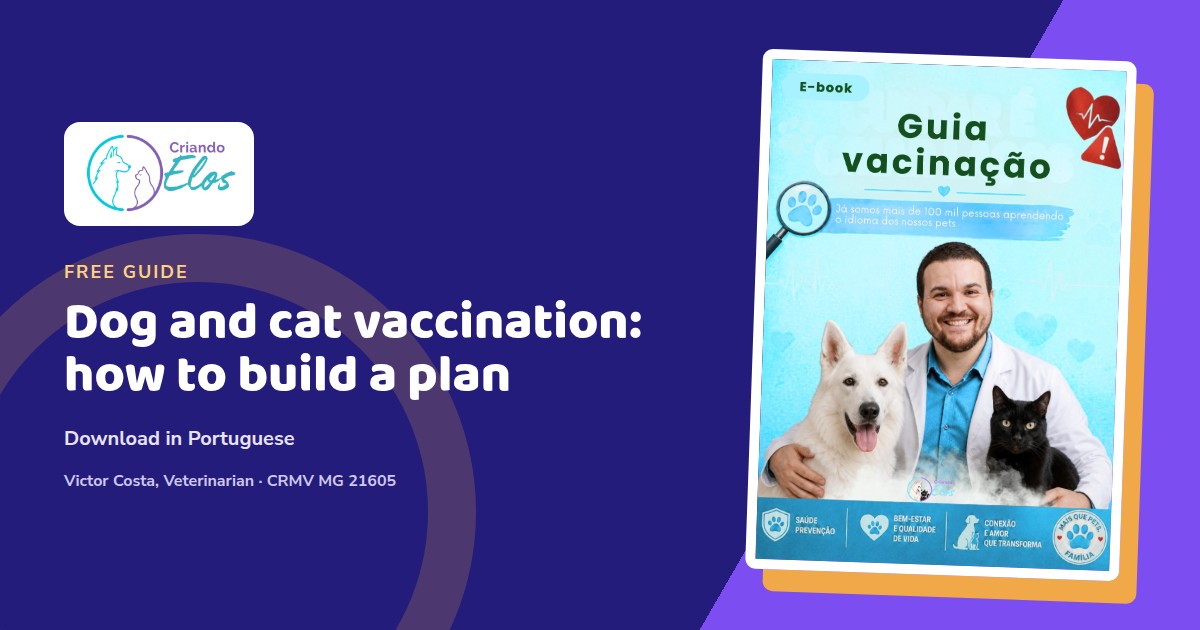
Editorial composition based on the original Criando Elos ebook.
A vaccination card full of dates can still leave the main question unanswered: which diseases is this animal protected against now? A useful plan starts with species, age, history, and exposure. A vaccine’s trade name cannot answer that on its own.
This guide will help you prepare for a conversation with your veterinarian. It does not replace an examination, the product label, local health rules, or an individual protocol. Puppies and kittens, adults with no records, animals with a previous reaction, and pets about to travel need different decisions.
Start with the diseases, not the number on the label
Names such as V8, V10, and V14 for dogs, or V3, V4, and V5 for cats, are market labels for combination products in countries such as Brazil. A larger number does not prove that one option is better for a particular animal. The veterinarian needs to check the antigens, the variants or serogroups covered by the license, and the duration of immunity stated on the product information.
The 2024 WSAVA vaccination guidelines classify vaccines as core, non-core, or not recommended. “Core” means that protection belongs in the plan for every animal to which that risk applies, after considering where the pet lives or travels. “Non-core” does not mean unnecessary. It may be a high priority for a pet exposed to a particular infection.
| Decision | Dogs | Cats | What changes the choice |
|---|---|---|---|
| Global core protection | Distemper, canine adenovirus, and parvovirus | Panleukopenia, feline herpesvirus, and calicivirus | Age, history, vaccine type, and interference from maternal antibodies |
| Rabies | Core where rabies is endemic | Core where rabies is endemic | Epidemiology, local rules, product label, and travel |
| Relevant regional risk | Leptospirosis is core where the disease occurs, relevant serogroups are known, and a suitable vaccine is available | FeLV may be core for young cats where it circulates and for exposed adults | Region, outdoor access, household contacts, and available product |
| Exposure-based protection | Respiratory vaccines may be appropriate for daycare, boarding, shelters, or frequent dog contact | Chlamydia or Bordetella vaccines are reserved for specific situations, such as groups with confirmed disease | Frequency and type of contact with other animals |
In Brazil, urban rabies caused by the classic dog variants has fallen sharply, but wildlife variants still infect dogs and cats. The Brazilian Ministry of Health identifies surveillance and rabies vaccination as central preventive measures. Cats still need attention even if they live at home because hunting can bring them into contact with bats.
Leptospirosis also belongs in the Brazilian conversation. The Ministry of Health classifies it as endemic in Brazil, with most probable human infection sites reported in urban and household settings and greater incidence during rainy periods. That evidence shows the risk is not confined to farms. For a dog, vaccine selection still depends on local canine epidemiology, relevant serogroups, and available products.
For young animals, the end of the series matters
Puppies and kittens receive a series because antibodies acquired from their mother can neutralize an early dose before the young animal develops its own response. Maternal protection wanes at different times, even within one litter, so a calendar built around exact days creates a false sense of precision.
WSAVA advises starting core viral vaccines within an age range and repeating them at intervals until at least 16 weeks of age, with an extension in high-risk settings. The lesson for an owner is not a universal list of dates. It is the need to confirm when the series began, which products were given, and whether there was an effective dose after the period when maternal interference is most likely.
Two animals of the same age may therefore leave with different plans. One came from a known home with a vaccinated mother. The other was rescued, stayed in a shelter, and has no reliable record. Health on the day, exposure, a local outbreak, and the product label also affect the decision.
Do not decide on your own that a first dose makes an animal ready for walks, daycare, or contact with unfamiliar pets. The timing of wider social contact must balance infection control with safe socialization, guided by a veterinary team that understands local risk.
For an adult with an incomplete or unknown history, appearance, age, and a vague memory cannot reconstruct protection. Bring every record you have and let the veterinary team design a catch-up strategy. Some modified-live vaccines protect many adults after one dose; other products require a primary series or a restart after a long lapse. That difference is one reason a single schedule cannot fit every pet.
Individual risk changes throughout life
“Indoor only” is useful information, but it is incomplete. A cat may get a new housemate, stay at a boarding facility, escape, reach a balcony visited by bats, or live with another cat that roams. An apartment dog may start daycare, travel to a region with different disease circulation, or walk through areas affected by floodwater and rodents.
For dogs, the AAHA guidelines, updated in 2024, now place leptospirosis among core vaccines and consider Bordetella and canine influenza according to lifestyle and exposure. WSAVA uses a more region-dependent definition for leptospirosis. Both sources support the practical point for owners: reassess the plan whenever risk changes.
For cats, WSAVA considers FeLV vaccination core for young cats in regions where the virus circulates and risk-based after that stage. It also recommends testing before vaccination and vaccinating only FeLV-negative cats. Vaccination lowers risk, but preventing contact with infected cats remains the safest form of protection.
Bring this information to the appointment:
- whether the pet has unrestricted outdoor access or could escape;
- whether it lives with dogs or cats that go outside;
- whether it visits a groomer, daycare, boarding facility, show, shelter, or dog park;
- whether it has moved, will travel, or will share the home with a new animal;
- possible contact with floodwater, mud, sewage, rodents, bats, or wildlife;
- chronic disease, immunosuppressive medication, pregnancy, or any previous postvaccination reaction.
These answers do not diagnose disease or automatically indicate a vaccine. They give the veterinarian context that the vaccination card cannot show.
A yearly check does not mean every vaccine every year
Reviewing the plan each year is different from repeating every component annually. WSAVA states that some core viral vaccines for dogs can be given much less often after an adequate initial series. Others, including leptospirosis and several exposure-related vaccines, offer shorter protection and may require annual doses according to risk and the product label. Intervals in cats also vary by antigen, product, and lifestyle.
Rabies vaccination follows local health rules and the licensed duration of the product. Brazilian public health guidance recommends annual rabies vaccination for dogs and cats, but owners should confirm local campaigns, accepted documents, and available products with their municipality and veterinarian. A dose without a valid record may not satisfy a travel or administrative requirement.
In selected cases, antibody testing can help with booster decisions for canine distemper, adenovirus, and parvovirus, or feline panleukopenia. It is not a general replacement for every vaccine. WSAVA cautions that titers for other agents, including Leptospira, are much less reliable predictors of protection. Rabies antibody tests also sit within separate legal frameworks, especially for travel.
Heartworm prevention belongs outside the vaccination record as well. Oral, topical, and injectable antiparasitic drugs are available, including long-acting moxidectin. The Companion Animal Parasite Council classifies them as heartworm preventives, not vaccines. Testing, product choice, and timing form a separate plan based on region and mosquito exposure.
Make the record tell the whole story
A date and a loose sticker provide little help when a pet changes clinics, has a reaction, or travels. WSAVA recommends recording the date, the person who gave the vaccine, vaccine name, manufacturer, lot or serial number, expiration date, route, and anatomical site. The medical record should also flag a suspected reaction and state how long protection is expected to remain valid.
Before leaving the clinic, check that you can answer:
- which product was given and which diseases it covers;
- manufacturer, lot, expiration date, and administration date;
- route and injection site, especially for a cat;
- when the plan should be reviewed and which component is due first;
- what to watch for at home and whom to call if a reaction occurs;
- which documents will be needed for travel.
Recording the injection site in cats has an added purpose. Feline injection-site sarcomas are rare, but they can occur after vaccines and other injections. WSAVA advises against the area between the shoulder blades and regards distal limb injection as a reference practice because a mass there can be noticed and managed with a better chance of control. Tail vaccination remains an alternative under study, rather than a rule for every cat.
Start travel planning early. Brazil’s Ministry of Agriculture explains that international travel requires a health history and a document accepted by the destination. Some countries require a microchip, rabies vaccination in a specific order, antibody testing, and waiting periods that cannot be completed shortly before departure. For domestic travel in Brazil, the Ministry also lists valid proof of rabies vaccination and a health certificate among the required documents.
A previous reaction changes the plan
Local pain, a small swelling, reduced appetite, fever, sleepiness, or vomiting can occur after vaccination. Severe allergic reactions are less common. The team should explain what to expect for that product and pet, because intensity, duration, and the combination of signs matter more than an isolated checklist.
Rapid facial swelling, widespread hives, trouble breathing, profound weakness, fainting, collapse, or repeated vomiting after vaccination requires immediate veterinary contact. Tell the team at once if the animal is still at the clinic.
If a reaction occurred before, bring the product name, lot number if available, time of vaccination, onset of signs, photographs, and details of any treatment. Do not hide the history or attempt revaccination on your own. WSAVA notes that a previous serious reaction can change whether a booster is needed, prompt antibody testing for specific agents, require consultation with authorities for rabies, or lead the veterinarian to choose another formulation and closer monitoring.
For cats, monitor any lump at the injection site. The 3-2-1 rule endorsed by WSAVA calls for veterinary investigation when a mass persists for three months, is larger than two centimeters at any time, or is still growing one month after injection. Do not wait for those thresholds if the site is painful, ulcerated, growing rapidly, or accompanied by other concerning signs.
Frequently asked questions
Does an indoor pet still need vaccines?
It still needs a vaccination assessment. Core protection remains relevant, and indoor risk is not zero. Species, region, visiting animals, escapes, bats, travel, and prior history determine which components and intervals make sense.
Does V10 protect a dog better than V8?
The number alone cannot answer that. Ask the veterinarian to compare the antigens, serogroups, manufacturer, licensed use, and duration of immunity. The better choice covers the relevant risk with an appropriate, correctly stored product.
Does every cat need a V5 vaccine?
The V5 label alone cannot make that decision. FeLV protection requires prior testing and an assessment of age and exposure. Young cats and adults with outdoor access or contact with exposed cats deserve particular attention.
Should I restart if I lost the vaccination history?
Do not invent dates or repeat doses without an assessment. The veterinarian will design a catch-up plan using age, likely previous vaccination, vaccine type, current risk, and the product label. Antibody testing can help for selected agents.
Does a public rabies campaign replace the other vaccines?
Public dog and cat campaigns focus on rabies. A rabies vaccine does not protect against distemper, parvovirus, panleukopenia, FeLV, or leptospirosis. Bring campaign records to the appointment so the dose becomes part of the complete plan.
How soon after vaccination can a pet walk or travel?
There is no single waiting period. It depends on age, which dose was given, the product, time needed for an immune response, destination risk, and document requirements. Ask before exposing the animal or booking a trip.
Keep the vaccination record and photograph every page. Before the next appointment, use our guide to what to note before a vet visit and read how distemper affects dogs or how FeLV changes care for cats. The ebook available on this page is in Brazilian Portuguese, and the Criando Elos courses go deeper into preventive care.
Keep this guide for later
Enter your details to access the complete PDF. The downloadable material is in Brazilian Portuguese.
Material available in Brazilian Portuguese.The PDF’s schedule is not a universal protocol. Vaccines, intervals and boosters must be individualized by a veterinarian, as explained in the article.
Get the complete e-book
Enter your name, email and WhatsApp number. The download appears here after registration.
We could not send your details. Please try again.
Your details will register the request and allow communications related to Criando Elos.
Your e-book is ready
Guia de vacinação
Download the Portuguese PDFMaterial available in Brazilian Portuguese.This article is educational and does not replace an appointment with the veterinarian. In an emergency, seek care immediately.