
Rescuing cats: first care and safe separation
By Victor Costa, veterinarian (CRMV MG 21605, Brazil) · September 15, 2026 · 8 min
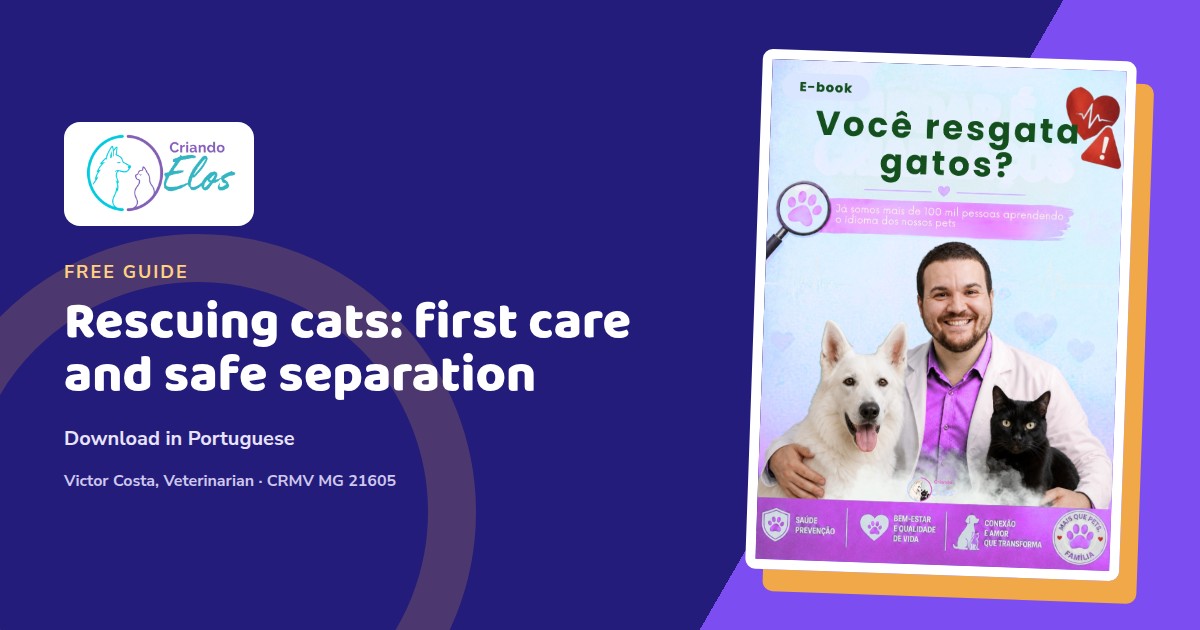
Editorial composition based on the original Criando Elos e-book.
The cat is finally inside the carrier. Before opening its door at home, prepare a separate room and arrange veterinary assessment. Introducing the newcomer to resident cats immediately makes it harder to track food intake, identify whose stool you found and prevent contact before screening.
This guide draws on the Criando Elos e-book Você resgata gatos? and veterinary and public health references. It is an educational synthesis for people taking cats into their homes or foster care. It does not replace an examination, diagnosis or a shelter’s veterinary protocol.
Arrange a safe route before handling the cat
Watch from a distance: can the cat walk, respond to its surroundings and breathe comfortably? Check for traffic, loose dogs and spaces where the animal could become trapped. Ask onlookers to step back and arrange a destination before attempting capture. Record where the cat was found and look for an owner when safe and practical, without delaying necessary care.
A frightened or painful cat can bite even after accepting a stroke. Do not corner or chase it, or pull its legs or tail. If a safe approach is not possible, contact a trained rescue team. Equipment and handling methods depend on the cat and the location; thick gloves do not make every approach safe.
Check the carrier’s latch and clear the route. Keep its door closed during transport. Tell the clinic about wounds, discharge, diarrhea or possible contact with sick animals so staff can plan the arrival.
Seek emergency veterinary care immediately for difficulty breathing, persistent open-mouth breathing at rest or collapse. Do not force food, water or medication. Cornell advises immediate veterinary care for breathing difficulty. Several conditions can cause it, and trying treatments at home can delay care.
Keep the newcomer separate and agree on a plan
The arrival room needs a door that closes, protection against escape and a layout that lets you observe the cat without repeatedly picking it up. Provide water, food suitable for its life stage, a litter box and an accessible hiding place. Keep the litter box away from food. Remove plants, chemicals and dangerous objects before arrival.
Separating a newcomer with an unknown history, quarantining an exposed cat and isolating a sick cat are different situations. Each needs its own placement and care decisions. ASPCA guidance on panleukopenia separates healthy, exposed and sick cats. A cat without visible illness can still shed this disease’s virus.
There is no single number of days that clears every rescued cat for shared housing. Agree with the veterinarian on release criteria, testing and reassessment based on history and risk. Separation should neither postpone the first appointment nor become indefinite confinement without follow-up.
Consider a practical arrangement, rather than a clinical case: a new foster cat develops diarrhea. With its own litter box, you can report when it started and how often it occurred. When several people clean a box shared by all the cats, that information can easily disappear.
| Situation | Initial placement | Information to record | Next decision |
|---|---|---|---|
| New arrival without visible illness | Separate from resident cats | Origin and known contacts | Assessment and integration plan |
| Known contact with a sick animal | Area designated for exposed animals | Date and type of exposure | Specific veterinary guidance |
| Cat showing signs of illness | Separate from other newcomers too | Signs and observed onset | Assessment and isolation plan |
Record observations without diagnosing
At arrival and during care, record appetite, drinking, urine, stool and behavior. Write what you actually saw: “did not touch the food offered,” “discharge from the left eye” or “vomited twice.” Avoid filling the record with assumed diagnoses such as “cat flu” or “worms.”
Food refusal, marked lethargy, vomiting, diarrhea or discharge from the eyes or nose warrant prompt veterinary contact. Kittens and weakened cats need particular attention. Silence or lack of movement does not prove a cat is relaxed. The CDC recommends contacting a veterinarian when signs of illness appear, including after an apparently uncomplicated adoption.
Photograph wounds only if you can do so without additional restraint. A bald patch does not confirm ringworm; an open sore does not confirm sporotrichosis. Report similar signs in other animals or people. Use what to note before a vet visit to organize useful details.
FelineVMA recommends assessment for FIV and FeLV after acquisition and according to exposure. A single test does not always establish infection status; repeat or confirmatory testing may be needed. A negative result does not clear a cat of every infectious disease. The guide to FeLV in cats explains more.
Bring available vaccination records, identification, earlier treatments and test results. Write “unknown” where information is missing. Vaccination and parasite prevention belong in the individual care plan. Do not apply products intended for dogs or reuse another rescued animal’s medication.
Make hygiene workable every day
Assign bowls, litter boxes, cloths and tools to each area. Label supplies so every caregiver understands the arrangement. A closed door cannot solve the problem if the same scoop or bucket travels between rooms. Agree on who cares for each group and where used equipment belongs.
Cleaning removes dirt; disinfection requires a suitable product. The Merck Veterinary Manual recommends selecting disinfectants for the target organism and the species’ safety. Follow the label for dilution, contact and rinsing. Remove cats during application and return them only to safe, dry surroundings. Never mix products.
Use a short routine check instead of relying on memory:
- Each cat or group has identification and assigned supplies.
- Food offered and food accepted are recorded.
- Stool, urine and vomit are observed before removal.
- Clean replacements are available for soiled items.
- Caregivers wash their hands and report changes after care.
- Veterinary contact and transport arrangements are available.
This checklist organizes work; it does not determine whether a cat is healthy. If nobody can complete the care or shortages force equipment sharing, limit new arrivals and seek support. Capacity depends on the setup and the care you can provide, rather than a universal maximum number of cats.
Protect the people doing the rescue
Zoonoses are infections that can pass between animals and people. Wash your hands after touching the cat, its supplies or litter box, including when you use gloves. Keep children away from feces and handling procedures. Whenever possible, pregnant or immunocompromised people should have another adult clean litter boxes and discuss precautions with their healthcare team.
Sporotrichosis deserves attention during rescue, particularly where transmission among cats occurs. The CDC describes transmission through bites, scratches and contact with infected animals. Avoid direct contact with sores and discharge, notify the veterinarian before transport and ask about suitable protection. Do not apply ointments on your own or abandon an animal because infection is suspected.
After a bite or scratch, wash the wound immediately with soap and water. Seek medical attention promptly, especially when the cat’s history is unknown, the wound is deep or pain, redness or swelling develops. Explain that the injury happened during a rescue. Healthcare staff will assess infection, tetanus and rabies risk. Do not wait for the cat’s test results before seeking care for the exposed person.
Common questions about rescuing cats
Can a clean, healthy-looking cat spread infection?
Yes. Appearance and cleanliness cannot exclude infection. Keep the initial separation arrangements and veterinary assessment even if the cat is active and eating.
Is ten days of quarantine enough?
That cannot be used as a universal rule. The veterinarian sets duration and release criteria according to exposure, signs and testing. A new exposure also changes the assessment.
Can two rescued cats keep each other company?
Do not assume they share the same history. Tell the veterinarian where each came from before creating a group. Companionship does not replace an assessment of compatibility and infection risk.
Should I bathe the cat immediately?
Do not make bathing a compulsory part of rescue. A frightened or sick cat may need assessment first. If a toxic substance is on its coat, seek immediate advice about decontamination.
Can I give antibiotics as a precaution?
Do not medicate on your own. Treatment depends on examination and the suspected cause; reusing an old prescription can delay the care the cat needs.
When can the newcomer meet my resident cats?
Once the veterinary health criteria are met, plan a gradual introduction. Health clearance and acceptance between cats are separate steps. Continue tracking appetite, elimination and behavior throughout introductions.
To prepare before the next arrival, use the registration below to access the original e-book, available in Brazilian Portuguese only. If the cat already shows a change, prioritize when to go to the vet and bring your observation record to the appointment.
Keep this guide for later
Enter your details to access the complete PDF. The downloadable material is in Brazilian Portuguese.
Material available in Brazilian Portuguese.Get the complete e-book
Enter your name, email and WhatsApp number. The download appears here after registration.
We could not send your details. Please try again.
Your details will register the request and allow communications related to Criando Elos.
Your e-book is ready
Você resgata gatos?
Download the Portuguese PDFMaterial available in Brazilian Portuguese.This article is educational and does not replace an appointment with the veterinarian. In an emergency, seek care immediately.