
Rescuing puppies and kittens: first care
By Victor Costa, veterinarian (CRMV MG 21605, Brazil) · September 15, 2026 · 8 min
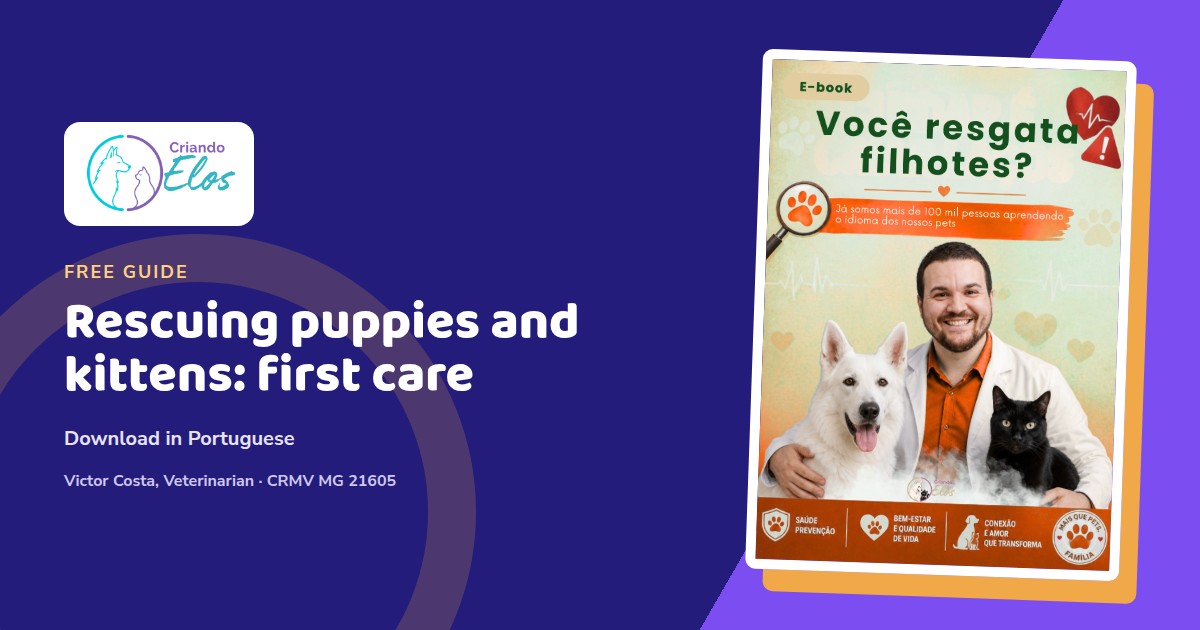
Editorial composition based on the original Criando Elos ebook.
Do not bottle-feed a chilled puppy or kitten. Warm the baby gradually and get veterinary guidance first. Hypothermia interferes with suckling and digestion and raises the risk of regurgitation and aspiration. In neonatal rescue, doing the right things in the wrong order can turn help into harm.
This guide covers puppies and kittens that still depend on their mother for warmth, milk, and hygiene. It supports the first decisions but cannot replace a veterinary examination. A newborn orphan can deteriorate quickly even when no injury is visible.
Before picking them up, check whether the mother may return
A litter found alone is not always orphaned. Watch from a distance and avoid surrounding the nest. The mother may be looking for food or hiding because people are nearby. This is especially common with community cats. The ASPCA recommends leaving stable kittens in place and monitoring for the mother’s return when the setting is safe.
Do not wait if the babies are cold, wet, injured, covered in insects, crying continuously, very weak, or exposed to traffic, rain, floodwater, direct sun, or predators. Move the litter out of immediate danger and contact a veterinary clinic, shelter, or rescue group experienced with neonates. If kittens only need to be moved away from a specific hazard, keep them as close to the original spot as safety allows so their mother can still find them.
The same cautious observation applies to puppies, but an exposed nest or scattered babies may also suggest that something happened to the mother dog. Look for her without entering an unsafe area or handling a frightened dog. If she returns, check whether she accepts the litter, whether the babies nurse, and whether everyone stays warm. Her presence does not remove the emergency if she is injured, ill, has no milk, or rejects a baby.
Record the location, time, number of babies, and what you saw before handling them. This helps the veterinary or rescue team estimate how long maternal care may have been absent and whether reunification is still possible.
Warm first and leave room to move away from the heat
Puppies and kittens under four weeks of age cannot regulate body temperature well. The Merck Veterinary Manual explains that hypothermia impairs immunity, nursing, and digestion. A chilled neonate needs gradual warming before food.
Dry the body with a soft towel and place the litter in a sturdy, draft-free box. A tightly sealed warm-water bottle or a pet-safe warming device can sit beneath half of the box, wrapped in several layers of fabric. Keep the other half free from direct heat so a baby that can crawl has somewhere to move. Never place the body directly on a hot-water bottle, heating element, nearby lamp, or any surface that may burn.
Measure the air at bedding height without resting the thermometer on the heat source. Merck’s reference table gives approximately 84 to 89 °F for week one, about 80 °F for weeks two and three, and 69 to 75 °F for week four. These are environmental references, not body-temperature targets or a promise of safety. Estimated age, humidity, litter size, and clinical condition all affect the amount of support required.
Do not rush warming with a hair dryer, very hot water, or direct heat. Do not bathe a chilled baby. If the puppy or kitten remains cold, limp, minimally responsive, or unable to suck while you arrange warming, treat the situation as a veterinary emergency.
Both need warmth, frequent feeding, help with elimination, and daily weight checks. Their milk, developmental timing, and infectious risks differ. When age is only an estimate, behavior and a veterinary examination are more useful than an assumed week count.
| Decision | Puppy | Kitten |
|---|---|---|
| Milk replacement | Commercial canine milk replacer | Commercial feline milk replacer |
| Feeding position | Belly supported, feet down, head aligned | Belly supported, feet down, head aligned |
| Elimination | Some begin eliminating independently sooner, but the caregiver still needs to confirm spontaneous urine and stool | Many still need stimulation until roughly three to four weeks of age |
| Weaning | Transition commonly begins during the third or fourth week, based on development and professional guidance | Transition commonly begins around the fourth week, based on development and professional guidance |
| Prevention | The plan considers canine diseases, origin, and exposure | The plan considers feline diseases, origin, exposure, and contact with other cats |
These ranges are not deadlines for stopping care. A baby that does not eliminate, gain weight, or eat independently remains dependent regardless of the age assigned to it.
Feed without force or improvised recipes
If the mother cannot nurse, use commercial milk replacer made for the baby’s species. Cow’s milk, condensed milk, cream, egg yolks, and online mixtures do not reproduce maternal milk and can disrupt fluid, energy, and nutrient balance. Merck considers commercial replacers better than homemade formulas. Do not substitute the other species’ product for convenience.
Mix the product exactly as directed on the label, using clean equipment. Extra powder does not make the formula safely more nutritious; it can make the mixture too concentrated and contribute to discomfort or diarrhea. Extra water can reduce the energy delivered. Volume and timing must account for species, current weight, estimated age, clinical condition, and the product’s caloric density. Ask the team for a written plan and weigh each baby in grams at the same time every day.
Place the puppy or kitten on its belly with feet facing down and the neck in a natural position. Never cradle a neonate on its back like a human baby. The ASPCA kitten bottle-feeding guide advises against squeezing the bottle or force-feeding milk or water because fluid can enter the airway. Puppies need the same caution. Best Friends’ orphaned puppy guide recommends feeding on the belly with slow flow and getting hands-on veterinary training before any tube feeding.
Watch the rhythm. The baby should suck and swallow without coughing, struggling to breathe, or leaking milk from the nose. Stop immediately if any of these occur and seek care, even if the baby seems better afterward. Do not use a syringe to squirt formula into the mouth of a weak neonate. No suckle reflex, persistent refusal, or inability to swallow calls for an examination, not more pressure on the bottle.
Wash the bottle and nipple after each use. Follow the manufacturer’s refrigeration instructions and discard formula that has been warmed, contaminated, or left out longer than the product allows. A warm-water bath lets you test the formula on your wrist and reduces hot spots. A microwave may heat unevenly.
Stimulate elimination and record what happens
A mother licks the genital and anal area to trigger elimination. When she is absent, gently stroke those areas with cotton, gauze, or a very soft cloth dampened with warm water after feeding. Stop once the baby eliminates and dry the skin. Prolonged rubbing can cause irritation.
Maddie’s Fund guidance for orphaned puppies and kittens explains that young babies may depend on stimulation until three to four weeks of age. Some puppies begin eliminating on their own earlier. The practical test is consistent spontaneous urine and stool, rather than assuming that a birthday switched the function on.
Keep a separate, simple record for each baby:
- daily weight in grams, using the same scale at a similar time;
- the time and amount actually taken at each feeding;
- urine and stool, including color, consistency, and any straining;
- environmental temperature and adjustments to the heat source;
- activity level, strength of suckle, and any coughing or regurgitation.
The log cannot diagnose a problem. It reveals change and prevents littermates from being confused with one another. Weight loss, failure to gain, a painful or enlarged abdomen, straining without elimination, blood, diarrhea, or a sudden behavior change should be reported promptly to the care team.
These signs cannot wait until the next feeding
Labored breathing, blue, gray, or very pale gums, limpness, unresponsiveness, seizure, trauma, bleeding, severe pain, milk coming from the nose, or coughing after a feeding require immediate care. Call the emergency clinic and leave with the baby kept safely warm during transport. Do not force more food.
Persistent chill, refusal to nurse, continuous crying, vomiting, diarrhea, a hard or markedly swollen abdomen, and falling weight also call for urgent contact. Neonates have little reserve of energy and fluid. The Merck Veterinary Manual lists failure to suckle, persistent diarrhea, unusual vocalization, abdominal distention, hypothermia, and breathing difficulty among signs associated with serious illness.
During transport, keep the warm source wrapped in fabric and away from direct skin contact. Bring the formula package, feeding log, and information about the mother and where the litter was found. Do not delay departure to finish notes, complete a feeding, or try a homemade recipe.
The first examination organizes the days ahead
Every orphaned neonate needs a veterinary examination as soon as possible, even after warming and nursing successfully. The team will look for dehydration, congenital problems, infection, parasites, trauma, umbilical disease, and difficulty suckling. They can also calculate a feeding plan and demonstrate technique before recommending a tube or other support.
Until then, keep the litter separate from household animals, use dedicated bedding and equipment, and wash your hands before and after care. Littermates can remain together unless the care team says otherwise, as contact helps conserve warmth. Do not mix litters or introduce an orphan to an unfamiliar adult animal on your own.
Vaccination and parasite control follow stabilization and use species-specific protocols. The 2024 WSAVA vaccination guidelines explain that maternal antibodies, age, species, vaccine product, environment, and regional risk affect the series. The first vaccine should not be chosen from a single age copied from a handout.
Once the baby is stable, gentle contact and behavioral development matter too. For now, the priorities are safe warmth, the right food, elimination, weight, and a fast response to any decline.
Frequently asked questions
Can I use cow’s milk until I buy formula?
No. Cow’s milk does not have the right composition for neonatal puppies or kittens and may cause digestive upset and diarrhea. Contact a clinic or rescue group for species-specific formula and immediate guidance.
Can a cold baby feed if it seems hungry?
Do not offer a bottle while the baby is cold and poorly responsive. Warm gradually and contact a veterinary team because hypothermia impairs digestion and swallowing and raises aspiration risk.
Can I use a syringe if the baby will not latch?
Do not squirt milk into the mouth. A neonate without a suckle reflex may be cold, weak, or ill, and fluid may enter the lungs. The team should assess the baby and demonstrate any alternative technique in person.
Do I need to stimulate elimination after every feeding?
Continue gentle stimulation after feedings while the baby cannot urinate and defecate consistently without help, following the care plan you received. Contact the veterinarian if nothing is produced or if you see straining, pain, blood, or swelling.
How much and how often should I feed?
The plan depends on weight, estimated age, species, clinical condition, and the chosen formula. Use the label as a reference and ask the team for an individual calculation. Free-choice feeding or one fixed schedule for an entire litter can provide too much or too little.
When should vaccines and deworming begin?
After examining the baby, the veterinarian sets the timing and intervals according to species, age, health, origin, product, and exposure risk. Do not give an antiparasitic product to a neonate without veterinary direction.
Use the guide on what to record before the veterinary visit to organize the details. If any sign changes during care, review when to go to the veterinarian and prioritize treatment. For a dog found beyond the neonatal stage, dog rescue and first care covers handling and isolation in more detail. The ebook offered on this page remains in Brazilian Portuguese, and the Criando Elos courses explore the subject further.
Keep this guide for later
Enter your details to access the complete PDF. The downloadable material is in Brazilian Portuguese.
Material available in Brazilian Portuguese.The PDF includes feeding recipes and intervals that need correction. Use a species-appropriate milk replacer and individual veterinary advice. Updated guidance appears in the article.
Get the complete e-book
Enter your name, email and WhatsApp number. The download appears here after registration.
We could not send your details. Please try again.
Your details will register the request and allow communications related to Criando Elos.
Your e-book is ready
Você resgata filhotes?
Download the Portuguese PDFMaterial available in Brazilian Portuguese.This article is educational and does not replace an appointment with the veterinarian. In an emergency, seek care immediately.