
Senior dog and cat checkups: what to assess
By Victor Costa, veterinarian (CRMV MG 21605, Brazil) · September 15, 2026 · 7 min
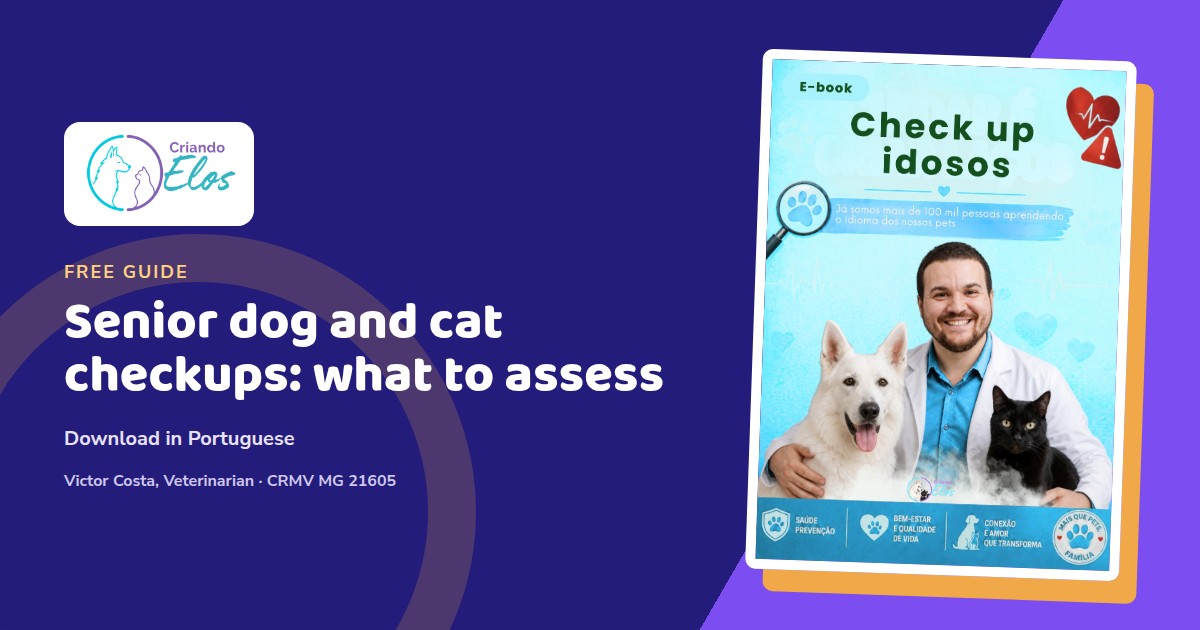
Editorial composition based on the original Criando Elos e-book.
Your cat has stopped jumping onto the bed. Your dog wants to turn back earlier on walks. Before putting these changes down to age, record when they started and contact your veterinarian. A senior pet checkup compares current health with previous records and investigates changes that everyday routines can hide.
This guide brings together veterinary references to help owners prepare for that conversation. It does not determine which tests an individual animal needs or replace an examination.
When to start and how often to return
Dogs do not all become seniors on the same birthday. Size, breed and expected lifespan affect that assessment. AAHA defines the senior stage in dogs as the final quarter of their estimated lifespan and considers cats older than ten to be seniors. These definitions help plan care; they do not predict how long your pet will live.
For cats aged ten to fifteen, the 2021 feline senior care guidelines recommend visits at least every six months. Cats older than fifteen should have examinations every four months even when they appear healthy. Existing illnesses may require closer follow-up.
For a dog, agree on a schedule with the veterinarian based on their individual condition. When booking, explain whether this is preventive care or whether something new has happened. An appointment several months away does not make it safe to wait if symptoms develop.
Ask for the next visit date and its purpose in writing: checking weight, reviewing a result or reassessing overall health, for example. This helps everyone at home understand what should happen before and after the appointment.
What the visit should cover beyond heart health
Senior care includes a discussion of life at home and a thorough physical examination. AAHA recommends reviewing food intake, movement, behavior and products being used, as well as examining the mouth, eyes, joints and other systems. Supplements belong in this conversation because they can interact with medicines.
Bring specific concerns. Instead of saying your dog is quieter, explain that they have stopped following the family to the front gate. If your cat has started urinating outside the litter box, mention whether getting into the box seems difficult and whether urine volume has changed. Your job is to describe what happens; the veterinarian interprets it.
In cats, less jumping, changes in grooming and altered litter box habits can accompany health problems. Cornell advises against automatically attributing these changes to aging. Report them even if your cat still eats and seeks affection.
Use this structure to organize observations:
| Part of daily life | Useful record | Question for the appointment |
|---|---|---|
| Eating | Food offered and amount left over | Are the amount and diet still appropriate? |
| Movement | A spontaneous video of walking or getting up | Does this difficulty need investigation? |
| Drinking and urination | The change noticed and when it began | Should we assess this change now? |
| Sleep and interaction | Timing and behavior observed | What could explain the change? |
| Medicines | Names, formulations and actual schedules | Is the current plan still appropriate? |
This table organizes information. It does not provide a diagnosis or a health score.
Which tests to discuss and what results cannot tell you
A complete blood count, blood chemistry and urinalysis appear in senior screening recommendations, with timing tailored to the patient. The AAHA testing table suggests intervals of six to twelve months for these tests and includes blood pressure and thyroid assessment. Imaging and cardiac testing depend on clinical indications and specific risks.
This does not mean buying a fixed testing package without a consultation. Ask what each test is meant to do: investigate a symptom, monitor a diagnosed illness or establish a reference for future comparisons. Those are different questions, and the tests needed may differ.
Bring complete previous reports, including dates, even if the results were considered normal. Ask how the current findings compare with the history and whether anything needs confirmation. One number cannot describe the animal’s entire condition.
If a result falls outside the reference range, ask the veterinarian to explain the next step. Does it confirm a condition, or does it still need interpretation alongside other information? Will a sample need to be repeated? Which question remains unanswered? A laboratory app flagging a value as abnormal is not a completed diagnosis.
If your budget is limited, say so early. Ask for written priorities: what is needed now, what could be arranged in stages and what information would be missing without a particular test. That discussion must account for current symptoms; it does not authorize delaying an urgent investigation.
How to prepare without adding unnecessary stress
Keep one note on your phone for this appointment. Record short factual observations, using approximate dates if you cannot remember the exact day. Nobody needs to reconstruct several months of daily life with impossible precision.
- Gather previous test reports and any available weight records.
- Photograph the packaging of medicines and supplements currently being used.
- Note the food offered, treats and any recent diet changes.
- Record changes in walks, litter box use, sleep or appetite.
- Bring a short video of a change that happens spontaneously and can be filmed safely.
- Ask the clinic about food, sample collection and medicines before the visit.
Do not impose fasting or stop a medicine yourself to prevent it from “affecting the test.” If preparation is necessary, request instructions for your pet and clarify anything uncertain before following them.
Consider this example of record keeping: “Since Saturday, avoids the patio step; still interested in going outside; I don’t know whether they slipped.” It identifies a change, gives an approximate starting point and admits what the family does not know. That is more useful than deciding in advance that the dog has arthritis. This is an illustration of how to write a note, not a clinical case.
Tell the team if traveling causes severe fear or your pet struggles to get into the car. Discuss arrival and handling beforehand. For more help organizing information, see what to note before the vet visit.
Which changes need an earlier assessment
Changes in thirst, appetite, weight, activity or behavior warrant contacting the clinic for advice about assessment. Mention vomiting, coughing or trouble moving as well. You do not need to wait for several symptoms to accumulate before calling.
Seek immediate veterinary care for difficulty breathing, blue or very pale gums, a seizure, extreme lethargy, severe pain or attempts to urinate without producing urine. The Merck Veterinary Manual lists these among signs requiring urgent attention. Do not delay departure to finish notes or record videos.
The associated e-book draws attention to tiring easily and changes in breathing. These deserve assessment but cannot identify heart disease on their own. Senior care needs to consider the whole animal. If your pet already has a cardiac history, bring the prescribed monitoring plan and read about heart disease in dogs and cats.
Frequently asked questions about senior checkups
My pet looks healthy. Is a visit still useful?
Yes. Preventive assessment provides a record of current health and an opportunity to discuss subtle changes. Explain what has stayed the same, too. Appetite, activity and normal routines give the conversation context. Looking healthy does not guarantee freedom from illness.
Does every senior pet need an echocardiogram twice a year?
There is no universal rule. The need for cardiac testing and repeat examinations depends on the history, clinical assessment, specific risks and any diagnosed disease. Ask why a particular interval has been recommended for your pet.
Do normal tests rule out every problem?
No. A result addresses what that test can assess. If a change persists, tell the clinic even when results show no abnormalities. Ask what has been clarified and what still needs investigation.
Can I assume extra sleep is simply due to age?
Do not draw that conclusion from age alone. Record when the pattern changed, whether sleep is interrupted and how active your pet is while awake. These observations help the veterinarian decide what to examine.
Should I switch to senior food before the appointment?
Bring the current food’s name, the amount offered and your questions first. Request an individual recommendation, particularly if your pet already has a prescribed diet. The word “senior” on a label does not by itself determine the right food for that patient.
Can I save every concern for the next scheduled visit?
Stable questions can go on your appointment list, but new symptoms warrant contacting the clinic. Breathing difficulty and other emergency signs require immediate care even if a checkup is coming soon.
Leave with a plan everyone at home understands
Before leaving, confirm when results will be available, who will explain them and how to get help if your pet changes at home. Write down the follow-up appointment and divide responsibilities among the people who feed, walk and medicate your pet. If an instruction will not fit your routine, discuss that during the visit.
The material associated with this page has a cover titled “Check up idosos,” but its contents focus on heart disease signs and care. Treat it as additional reading on that narrower subject, rather than a complete senior screening protocol. Your veterinarian’s individual instructions take priority over generic intervals in the material. The downloadable e-book is in Brazilian Portuguese.
Use this article to prepare your next conversation and explore Criando Elos courses to learn more about observing your pet’s daily life.
Keep this guide for later
Enter your details to access the complete PDF. The downloadable material is in Brazilian Portuguese.
Material available in Brazilian Portuguese.The PDF titled Check-up de idosos focuses on heart disease signs and care. This article covers general senior pet checkups. The e-book is in Brazilian Portuguese.
Get the complete e-book
Enter your name, email and WhatsApp number. The download appears here after registration.
We could not send your details. Please try again.
Your details will register the request and allow communications related to Criando Elos.
Your e-book is ready
Check-up de idosos
Download the Portuguese PDFMaterial available in Brazilian Portuguese.This article is educational and does not replace an appointment with the veterinarian. In an emergency, seek care immediately.