
Heart disease in dogs and cats: signs and care
By Victor Costa, veterinarian (CRMV MG 21605, Brazil) · September 08, 2026 · 6 min
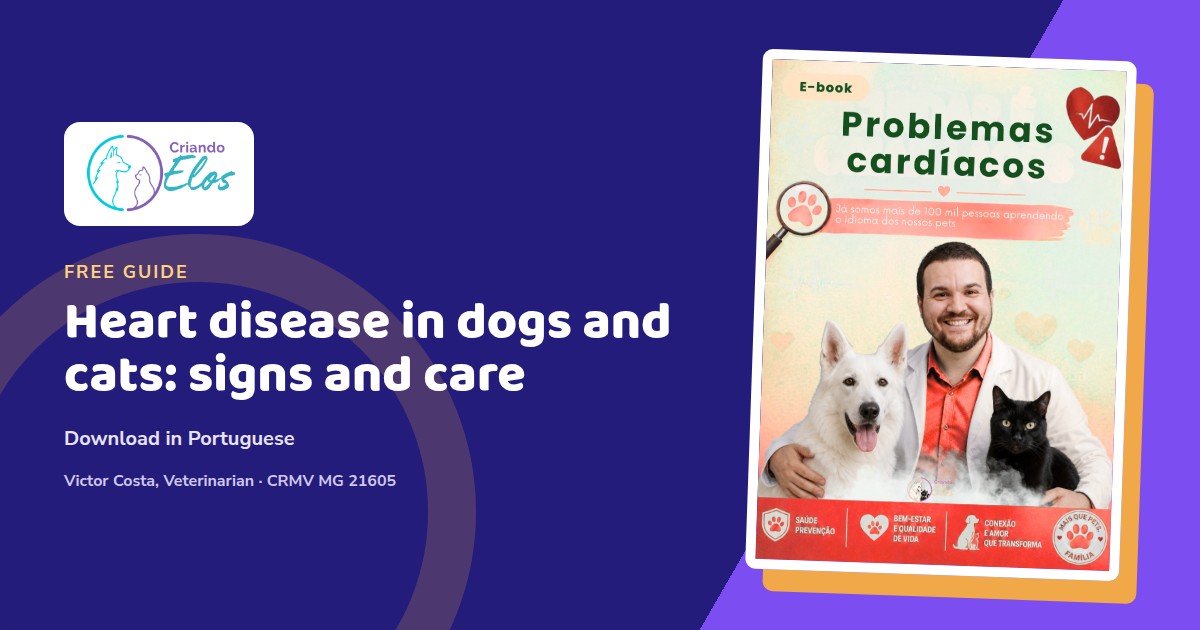
Editorial composition based on the original Criando Elos e-book.
Your dog has started stopping halfway through walks. Your cat breathes faster while sleeping. These changes need assessment, even without coughing or a previous diagnosis. If your pet is struggling to breathe, seek veterinary care immediately.
Heart disease can remain unnoticed for a time. This article brings together the Problemas cardíacos e-book and veterinary references to help you recognize changes and organize ongoing care. Diagnosis requires a veterinary consultation and appropriate tests.
When breathing changes require immediate care
Go to an emergency veterinary service now if your pet has difficulty breathing, a blue or purple tongue or gums, faints or collapses. A cat breathing with its mouth open, particularly at rest, also needs immediate care. Do not wait to finish a breathing count or complete a log.
The Merck Veterinary Manual lists breathing difficulty as an emergency. Call the clinic while arranging to leave, describe the signs and follow its transport instructions. Avoid restraint that compresses the chest, and do not force food, water or tablets during breathing distress.
Sudden pain and difficulty or inability to move a cat’s hind legs also require immediate attention. A blood clot associated with heart disease is one possible cause. Do not try to decide at home whether the problem involves the heart, bones or nervous system.
Heart disease and heart failure are different
Heart disease can affect the valves, heart muscle or other structures. Heart failure is a syndrome in which cardiovascular function becomes impaired enough to cause clinical signs. A pet with heart disease may not have heart failure.
In congestive heart failure, pressure changes encourage fluid to accumulate in the lungs or elsewhere. This helps explain why some patients have difficulty breathing. Merck explains the distinction between heart disease and heart failure.
Myxomatous mitral valve disease is common in small dogs, particularly older ones. Dilated cardiomyopathy affects the heart muscle and occurs in certain dogs, including large breeds. In cats, hypertrophic cardiomyopathy causes the heart walls to thicken. These names describe different changes; age or breed alone cannot establish a diagnosis.
Ask your veterinarian to write down the disease name, stage and purpose of monitoring. This helps you avoid comparing your pet’s prescription with another animal’s simply because both have been described as having a “heart condition.”
Changes to watch for in dogs and cats
Tiring earlier than usual, less interest in activity, rapid breathing at rest, coughing and episodes of weakness deserve a report. Note when they started and whether they are becoming more frequent. Do not make your pet run to test its stamina.
Coughing can accompany heart problems in dogs, but respiratory diseases also cause it. In cats, coughing is rarely caused by heart disease. Cornell describes these differences between species. An absence of coughing therefore cannot tell you that the heart is healthy.
Instead of writing only “seems tired,” describe the change: stopping on a previously easy part of a walk, no longer climbing to a favorite sleeping spot, or repeatedly changing position while resting. A short video can help, provided filming does not cause stress or delay care.
Feline asthma and tracheal collapse in dogs are examples of conditions that also affect breathing. Reading about similar signs can help you prepare questions, but it cannot identify the cause without an examination.
What heart tests can tell you
Your veterinarian combines the history, physical examination and tests selected for your pet. A murmur heard during an appointment may need investigation; it does not establish the disease stage or treatment on its own.
| Assessment | What it helps investigate | What it cannot answer alone | A useful question to ask |
|---|---|---|---|
| Echocardiogram | Heart structure and function | Every cause of breathing difficulty | What change was found? |
| Chest X-rays | Heart, lungs and signs of fluid buildup | Detailed valve motion | Is there evidence of congestion? |
| Electrocardiogram | Electrical activity and heart rhythm | The entire structure of the heart | Was an arrhythmia found? |
| Blood pressure and blood tests | Associated changes and conditions affecting care | The complete cardiac diagnosis | Does the result change the plan? |
High blood pressure and hyperthyroidism can cause heart wall thickening in cats and must be considered during investigation. Cornell explains the diagnosis of hypertrophic cardiomyopathy, including the role of ultrasound and complications from blood clots.
Bring prescriptions, previous results and a complete medication list. Ask which tests need repeating and what changes should bring the next appointment forward. There is no universal rule that every pet with heart disease needs every test repeated at six months. During breathing distress, stabilization may take priority over completing the investigation.
How to organize care at home
Breathing counts work best when your veterinarian demonstrates the technique and agrees with you on how to use the results. Texas A&M’s guidance on home breathing rates uses a pet sleeping comfortably or resting quietly. Do not count while the animal is panting or the cat is purring.
- Watch the chest without waking or holding your pet.
- Count one rise and fall as one breath.
- Count for 60 seconds and record the date, time and circumstances.
- Compare with your pet’s usual pattern and report increases or changes to the team.
Repeated counts above approximately 30 breaths per minute during sleep warrant veterinary contact. Your pet’s individual threshold may be lower. This number does not diagnose heart failure or make it safe to wait when breathing is labored. Agree with the team on how often to record it.
Use this list to organize care, without scoring the answers or treating checkmarks as a diagnosis:
- Record the medication, dose already prescribed, time and person giving it.
- Note missed doses, vomiting after medication or difficulty administering it.
- Observe appetite, energy and changes in breathing.
- Keep prescriptions, test results and the emergency phone number accessible.
- Confirm the next appointment and signs that require earlier contact.
If two people care for your pet, keep the record in one shared place. For example, marking an administration as soon as the medicine is given avoids making the second person depend on a message that has not yet been answered. Do not stop, increase or double doses on your own.
Treatment depends on the disease and stage. Some patients need monitoring without medication at that time; others need ongoing medicines and adjustments. Diuretics may be used to control accumulated fluid, but they are not a home remedy for every cough.
Discuss food and activity too. Tufts recommends individualized nutrition for pets with heart disease: weight, muscle mass, sodium and other nutrients influence the plan. Include treats, supplements and foods used to hide tablets in that conversation. Strict salt restriction is not a universal rule.
Agree on suitable walks and play. Stop if your pet cannot tolerate an activity and report the change. Do not force its previous pace or impose complete rest solely because of the diagnosis without veterinary advice.
Frequently asked questions
Does every murmur mean heart failure?
No. A murmur is a sound heard through a stethoscope. The team interprets it alongside the examination and, when indicated, tests to establish the cause and severity.
My cat does not cough. Can I rule out heart disease?
No. Cats with heart disease may not cough and may show no obvious signs for a time. Changes in breathing or energy need assessment.
Is more than 30 breaths per minute always an emergency?
The count needs context and an individual threshold. Repeatedly elevated counts during sleep warrant veterinary contact; labored breathing, collapse or purple gums require immediate care, whatever the number.
I missed a dose. Can I give two later?
Do not double it on your own. Check the prescription instructions or contact the team with the medication name, scheduled time and what happened.
Should every follow-up be at six months?
No. Timing depends on the disease, stage, treatment and progress. A clinical change may require assessment before the scheduled date.
Can heart disease be cured?
It depends on the cause. Many conditions require prolonged monitoring and management of signs, but describing every heart condition as irreversible is inaccurate. Ask about your own pet’s prognosis rather than treating another animal’s progress as a prediction.
Bring your observations to the next appointment
Organize the history with what to note before a vet visit. For further learning about pet care, explore Criando Elos courses.
The Problemas cardíacos e-book is available through the registration below in Brazilian Portuguese only. Use it as educational material alongside the updated guidance in this article and your veterinarian’s plan. It does not replace an assessment of your pet.
Keep this guide for later
Enter your details to access the complete PDF. The downloadable material is in Brazilian Portuguese.
Material available in Brazilian Portuguese.Get the complete e-book
Enter your name, email and WhatsApp number. The download appears here after registration.
We could not send your details. Please try again.
Your details will register the request and allow communications related to Criando Elos.
Your e-book is ready
Problemas cardíacos
Download the Portuguese PDFMaterial available in Brazilian Portuguese.This article is educational and does not replace an appointment with the veterinarian. In an emergency, seek care immediately.