
Environmental enrichment for dogs and cats
By Victor Costa, veterinarian (CRMV MG 21605, Brazil) · September 15, 2026 · 9 min
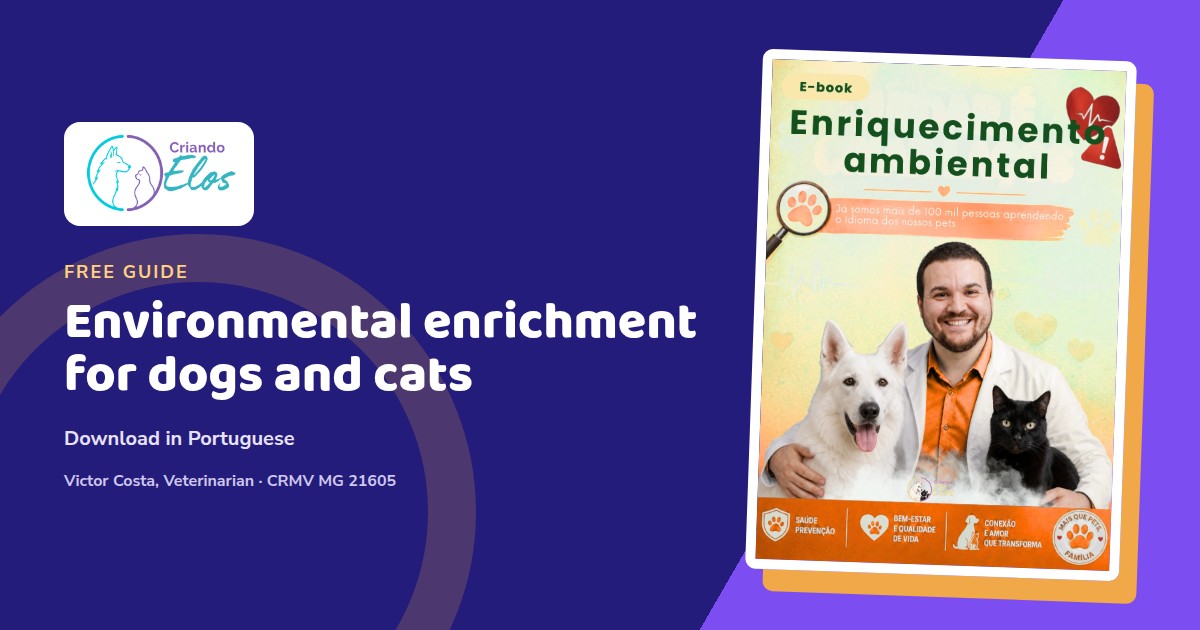
Editorial composition based on the original Criando Elos ebook.
A dog gets a stuffed toy and walks away after two minutes. A cat gets a new shelf and will not go near it. This does not prove the pet is lazy or that enrichment has failed. It usually means the activity, difficulty, or timing did not suit that animal.
Environmental enrichment creates safe opportunities to explore, choose, find food, play, rest, and interact. It has to respect the species and the individual. What settles one dog may excite another. What entertains one cat may frighten the cat living beside them.
Enrichment meets needs but does not explain every symptom
An activity is enriching when it allows behavior that matters to the animal and produces a response consistent with good welfare. Scattering many toys across the floor is not enough. The pet must be able to use the resource without fear, pain, competition, or excessive frustration.
Destruction, vocalizing, licking the body, hiding, or eliminating outside the usual place can be related to a limited environment. They can also result from pain, skin disease, gastrointestinal problems, urinary disease, fear, or a behavioral disorder. The Merck Veterinary Manual advises ruling out medical causes before diagnosing a behavior problem. A sudden change needs investigation even when the home seems monotonous.
Enrichment may be part of prevention, management, or treatment, depending on the case. It is not a universal treatment, and it does not replace an examination, a structured behavior modification plan, or medication when those are indicated. The AAHA guidelines place health assessment, environment, positive reinforcement, and follow-up within one individualized plan.
Punishing an animal for an activity you would rather not see is also counterproductive. Digging, scratching, chewing, and chasing belong to normal behavioral repertoires in suitable contexts. Offer a safe outlet for that behavior and teach alternatives with rewards. AVSAB continues to recommend reward-based methods and rejects aversive techniques.
Dogs and cats need different starting points
Both species benefit from movement, food that involves some participation, easy challenges, and predictable interaction. The way you provide these opportunities differs considerably.
| Need | For dogs | For cats |
|---|---|---|
| Explore | A walk with time to sniff, a quiet route, and safe surfaces | Elevated spaces, boxes, tunnels, and protected visual access |
| Find food | Part of a meal scattered in a clean area, a snuffle mat, or a sturdy toy | Small portions in accessible places or an easy, stable puzzle |
| Use the body | Health-appropriate walks, tug with rules, and retrieving games | Short sequences of stalking, chasing, catching, and receiving a small food portion |
| Mark and organize space | An approved place to dig or chew when that suits the dog | Stable vertical and horizontal scratching surfaces near resting and travel areas |
| Interact | Contact with people and, for social dogs, chosen and well-managed encounters | Contact at the cat’s pace; interaction between cats should not be forced |
| Recover | Breaks, sleep, and a place where nobody disturbs them | Hiding and resting spaces with clear ways in and out |
An enriching walk does not have to be long or fast. Pausing to investigate scents and varying the route can provide new information without turning the outing into a run. The behavior team at UC Davis recommends allowing dogs to explore on walks and warns that not every online enrichment idea is safe.
For a cat, think about territory first. The Feline Veterinary Medical Association organizes feline needs into five pillars: a safe place, separated resources, opportunities for play and predatory behavior, positive human interaction, and respect for scent. In multicat homes, food, water, litter boxes, resting places, and scratching surfaces need to be distributed. Placing everything side by side creates a single area that another cat can block.
Company is not automatically enriching either. A dog does not have to visit a crowded dog park to have a social life. A cat does not need a second cat as a cure for loneliness. Social contact helps only when there is compatibility, choice, and room to move away.
Food, toys, and sensory activities need a safety check
Use part of the daily food allowance in games instead of adding uncontrolled treats. If a pet has allergies, gastrointestinal disease, obesity, swallowing difficulty, or a therapeutic diet, ask the veterinarian which foods and formats fit the plan. Fresh water and a reliable way to eat must remain available.
For cats, introduce a food puzzle beside the usual bowl and make the food easy to obtain. A clinical review of food puzzles for cats recommends keeping some food in the bowl at first, watching for stress, and increasing difficulty gradually. The authors also acknowledge that the evidence is still limited and that puzzles are usually one part of a broader plan.
Do not let a vulnerable cat miss meals because they did not understand the toy. Reduced intake, food refusal, or persistent frustrated effort calls for an easier format and veterinary advice if it continues. In a home with several animals, offer food in separate locations to prevent theft and intimidation.
For dogs, a toy must withstand that individual’s chewing style and be large enough that it cannot be swallowed. Supervise the first uses. Remove cracked, loose, or small pieces. If the dog guards resources, do not grab the object or set up a confrontation. Get help developing a safe strategy.
String, ribbon, elastic bands, and hanging toys can be swallowed or cause entanglement and injury. Use them only under supervision and put them away afterward. Shelves must hold the cat’s weight, windows need secure screens, and accessible plants must be nontoxic. Strong smells and new sounds can also be unpleasant. Low volume and an open route out of the area are better than forced exposure.
Start easy and let the animal’s response guide progress
Change one thing at a time. This makes it easier to see what attracted, frightened, or tired the pet. A simple plan for the first week is often more useful than a box full of new items.
- Choose a behavior the animal already enjoys, such as sniffing, tearing safe paper, chasing a wand toy, or resting up high.
- Set aside part of the daily food allowance if the activity involves food.
- Prepare an area without competition, slippery flooring, a blocked escape route, or objects that could be swallowed.
- Present the easiest version and let the pet choose whether to approach or leave.
- Watch posture, appetite, and recovery during and after the activity.
- Increase one variable only, such as duration, distance, or difficulty.
- Record what worked and alternate activity with real rest.
Interest with a loose body is the signal to progress. The animal investigates, solves part of the task, pauses, and can walk away. Enthusiasm is not the only sign of engagement. A cat that watches from a distance before using a box or a dog that sniffs slowly may still be involved.
Make the task easier if the pet repeatedly leaves, loses interest in food, vocalizes, claws intensely at the object, guards the resource, or stays agitated long afterward. Stop for trembling, escape attempts, marked changes in breathing, conflict between animals, or injury risk. Exhaustion at any cost is not the goal.
Variety does not require something new every day. Some animals prefer predictability. You can alternate between two routes, move a few food portions, or rotate a small set of toys. If an activity works only when the animal is very hungry, frustrated, or unable to leave, it needs revision.
When behavior needs veterinary assessment
Contact a veterinarian when a change starts suddenly, worsens, causes a wound, changes sleep or appetite, prevents rest, or appears with vomiting, diarrhea, difficulty urinating, limping, sensitivity to touch, or disorientation. Licking a paw until it is sore may involve pain, allergy, infection, or a neurological problem. Filling the home with toys will not treat those causes.
The guide to behavior, disease, and individual traits helps separate a longstanding habit from a clinical change. Record what happens before, during, and after an episode, along with its frequency, duration, and a safely recorded video. The article on what to note before the veterinary visit helps organize those details.
Seek prompt care if the pet injures themselves, swallows part of a toy, strains to urinate without producing urine, has trouble breathing, collapses, has a seizure, or becomes severely disoriented. Remove access to the object only if you can do so without a bite, confrontation, or additional danger.
When fear, anxiety, aggression, or repetitive behavior persists after the medical assessment, the veterinarian may recommend a qualified behavior professional. Enrichment can remain part of the environment, but treatment must fit the diagnosis and risk in that case.
Frequently asked questions
How much enrichment does a pet need each day?
There is no universal number. Offer short opportunities throughout the routine and watch interest, fatigue, and recovery. Species, age, health, temperament, and daily schedule all affect the appropriate amount.
Can every meal be served in a puzzle?
Some animals adapt to that routine, but the transition should be gradual and food intake must be checked. Keep an easy option for cats at first. Therapeutic diets and physical limitations require veterinary guidance.
Should I replace the toys every day?
No. Rotation can renew interest, but predictability also has value. Store some toys and bring them back gradually without removing essential environmental resources.
Does catnip work for every cat?
No. Responses differ, and some cats show no interest. Offer a small amount, allow the cat to leave, and stop if it causes agitation or conflict.
Will a second animal solve boredom?
It is not an automatic solution. Incompatibility can increase conflict and stress, especially between cats. The decision to adopt another animal must consider space, resources, health, and a gradual introduction.
Can enrichment cure separation anxiety?
No. A safe activity may support management, but separation anxiety requires assessment and a gradual plan. The guide to managing separation anxiety explains why a stuffed toy alone cannot measure or resolve distress.
Build a routine your pet can choose
Start with one easy activity, observe for a few days, and record the response. The ebook on this page offers ideas for varying the environment. Use it as a starting point while keeping veterinary assessment in the plan when there is a behavior change, pain, or risk. Explore the Criando Elos courses to learn more.
Keep this guide for later
Enter your details to access the complete PDF. The downloadable material is in Brazilian Portuguese.
Material available in Brazilian Portuguese.Get the complete e-book
Enter your name, email and WhatsApp number. The download appears here after registration.
We could not send your details. Please try again.
Your details will register the request and allow communications related to Criando Elos.
Your e-book is ready
Enriquecimento ambiental
Download the Portuguese PDFMaterial available in Brazilian Portuguese.This article is educational and does not replace an appointment with the veterinarian. In an emergency, seek care immediately.