
Pet first aid kit: what to keep at home
By Victor Costa, veterinarian (CRMV MG 21605, Brazil) · September 13, 2026 · 7 min
Gauze is in one drawer, saline in another, and the emergency number is buried in an old message. Putting together a first aid kit for dogs and cats starts with making everything easy to find before you need it.
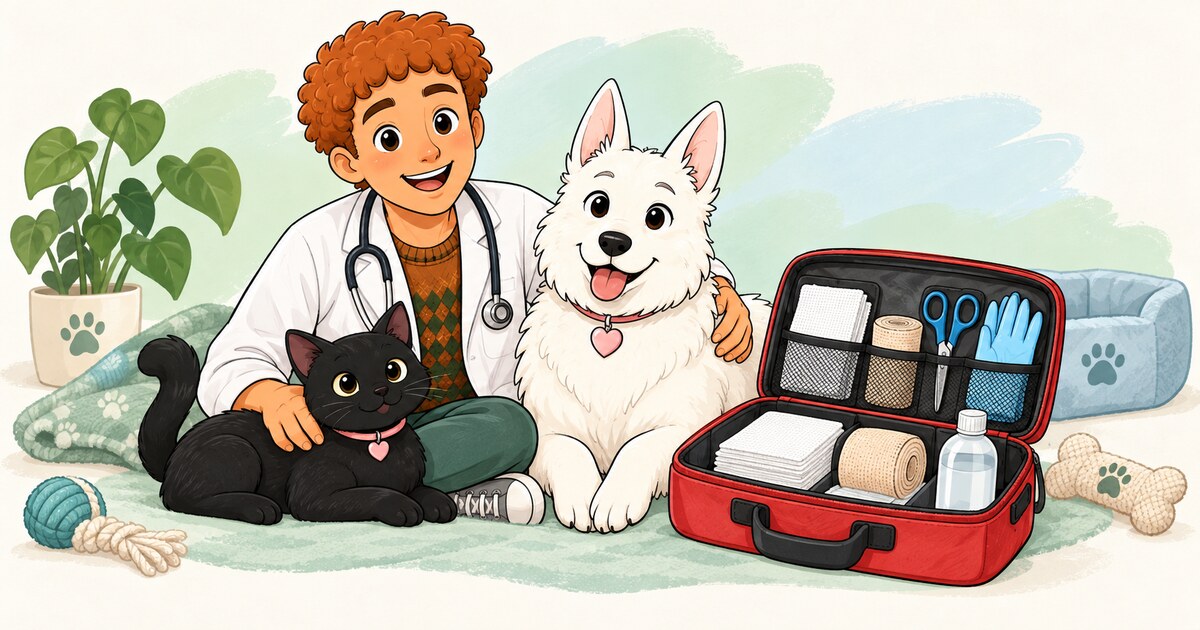
AI illustration based on the artwork provided to Criando Elos.
An emergency has started: what to do first
Check whether the surroundings are safe, contact an emergency veterinary hospital and arrange transport. Explain what happened and how your pet is doing. Trouble breathing, fainting, seizures, heavy bleeding or suspected poisoning cannot wait while you search for the perfect supplies.
Even a gentle animal may bite when in pain. Approach carefully, avoid unnecessary movement and follow the veterinary team’s instructions. For an injured cat, a carrier with a removable top can make it easier to place them inside without pushing them through a small door. VCA recommends minimizing handling, notifying the hospital and transporting the animal for care.
Do not force water, food or medication into the mouth of a pet that is struggling to breathe, having a seizure or unconscious. Do not muzzle an animal that is having trouble breathing or vomiting. The kit supports initial care and transport without delaying assessment.
Basic supplies for a pet first aid kit
Start with simple supplies and discuss specific products with your veterinarian. A labelled bag or box brings together items that are hard to find in a hurry when scattered around the house.
| What to pack | What it is for | Caution |
|---|---|---|
| Gauze and nonstick pads | Protecting a wound and helping with initial bleeding control | Do not remove embedded objects or probe the injury |
| 0.9% saline | Supporting cleaning as instructed | Check expiry, packaging and instructions after opening |
| Bandage roll and dressing tape | Keeping a protective dressing in place | Do not tighten it or stick tape directly to a wound |
| Blunt-ended scissors | Cutting gauze, tape and bandages | Do not use them to cut skin or remove something stuck in the body |
| Disposable gloves | Protecting your hands when touching secretions | Discard after use and clean your hands |
| Clean towel and blanket | Supporting transport and protecting surfaces | Do not compress the neck or chest; avoid overheating your pet |
The AVMA first aid checklist includes dressings, gloves, scissors, towels and emergency contacts. You do not need a case full of products to start getting organized.
If you have several pets, label items intended for an individual animal. A cone that fits a dog may not fit a cat. Keep the carrier and leash accessible, even if they do not fit inside the kit.
Which items require veterinary instructions?
A supply list is not a prescription. The product, concentration, application site and animal’s condition affect what is safe.
Chlorhexidine: different formulations exist. Do not choose a spray just because of its name. Ask the team to specify the product and explain where it can be used. The MSD Veterinary Manual warns that stronger solutions can harm healing tissue. Do not improvise dilutions or apply antiseptics to eyes or ears.
Needle-free syringe and pill dispenser: these may be part of prescribed care, but must not be used to force fluids or medication into an animal that cannot swallow normally. Ask for a demonstration before you need them.
Digital thermometer: keep one separate for your pet and learn how to use it from the team. If your pet resists, seems painful or struggles to breathe, do not insist on taking a temperature. The guide to fever in dogs and cats explains why touching the nose does not answer that question.
Activated charcoal: it is not a universal antidote. The AVMA limits its use to instructions from a veterinarian or specialist poison service. If you suspect your pet swallowed something toxic, seek help and bring the packaging or a picture of the product when it is safe to do so.
Razors and socks appear on some home lists. They are not basic tools for shaving around a wound or improvising restraint without training. An attempt to help can cut the skin, constrict a paw or make assessment harder. Prepare a sample container only when requested, with instructions about the container, storage and timing.
What not to improvise with household products
Do not use human medication, leftover ointment, alcohol or hydrogen peroxide on a wound on your own. MSD explains that hydrogen peroxide can damage healthy tissue and should not be used for wound lavage.
Do not induce vomiting after suspected poisoning without instructions. Whether it is appropriate depends on the substance, timing and animal’s condition. Having a bottle or medication at home does not mean it is suitable for that situation.
Keep regular medication labelled, with current instructions. Avoid unlabelled containers. If your veterinarian has prescribed an emergency plan for a particular condition, keep it with the supplies and ask when it needs reviewing.
Contacts and medical history belong in the kit too
Write down your clinic’s number and opening hours, plus the emergency hospital’s address. Confirm that the hospital treats dogs and cats and how after-hours care works. Save the route on your phone and keep a printed copy of the contacts in the bag.
Record your pet’s name, known conditions, current medication and allergies identified by the team. Include relevant test results or a simple way to find them. These details can be more useful during a call than carrying extra accessories.
For example, your dog stays with a relative while you travel. Along with food and a leash, provide the veterinary number, kit location and transport plan. Agree on who should be notified. You can arrange this before leaving, at a calm moment.
Where to keep the kit and how to check it
Choose a dry place away from heat and out of reach of pets and children. Every caregiver should know where it is. Keep supplies in their original packaging and follow the manufacturer’s storage conditions.
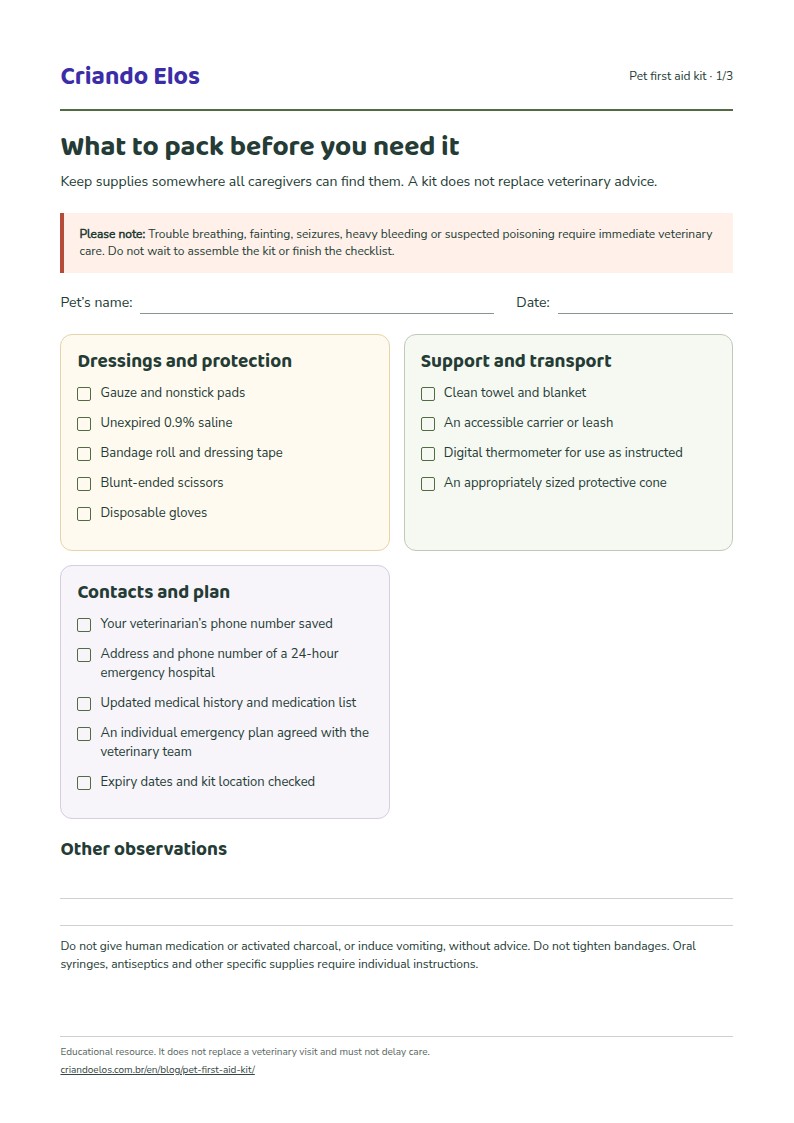
After using the kit, note what needs replacing. Periodic checks help avoid discovering in an emergency that the gauze is gone or the saline has expired. The PDF below includes a record for expiry dates, opening dates and replacements, along with an emergency plan.
Use the checklist to organize this task when things are calm. If your pet is unwell now, seek advice before continuing to read.
If the incident involves a houseplant, seed or bouquet, see the photo guide to plants poisonous to dogs and cats. It includes scientific names and warning signs; do not wait to identify the plant before seeking advice.
What have you already put in your kit?
Select only the items you have checked. This list organizes supplies; it does not assess your pet’s health or teach procedures.
See what I have packed
No items selected. Start with emergency contacts and basic supplies.
Your selections stay on this page and are not sent with the form.Having every item does not make it safe to give medication or perform procedures on your own. Add specific supplies as advised by your veterinarian.
A list for your kit and emergency contacts
Download the checklist image or the full three-page PDF to print and fill in by hand.
- Supplies and contacts checklist
- Expiry and replacement record
- Emergency plan to discuss with your veterinarian
Save the resource for later
Enter your details to access the files on this page. The interactive checklist above needs no registration.
We could not send your details. Please try again.
Questions about the first aid kit
Can I use the same kit for a dog and a cat?
Basic supplies can share a bag in clean, labelled packaging. Keep individual items and prescribed medication separate. A product recommended for one animal is not automatically appropriate for another.
Does the kit need medication?
Do not buy medication for an unspecified emergency. Start with support supplies and contacts. If your pet has a condition requiring rescue medication, ask your veterinarian for a written plan and keep the prescription with the product.
If the bleeding stops, should I still seek care?
The end of visible bleeding does not reveal how deep or contaminated a wound is. Bites, punctures, trauma and pain need assessment. Tell the team what happened even if the initial protection seems to have helped.
Does a protective cone replace a dressing?
It may help prevent licking or biting the area, but dressing needs and cone size depend on the case. Check the fit with the team. If your pet is struggling to breathe, prioritize care and avoid handling them to put on accessories.
Can I treat an emergency at home with the kit?
The kit gathers supplies for initial support. It does not replace diagnosis, treatment or practical training. Recognizing your limits and leaving for veterinary care is part of first aid too.
To prepare for a call, read when to go to the vet and what to note before an appointment.
Clinical content reviewed and approved by Victor Costa, veterinarian (CRMV MG 21605, Brazil). Translation of the reviewed Brazilian Portuguese content.
This article is educational and does not replace an appointment with the veterinarian. In an emergency, seek care immediately.